
by RJ Michaels
By the time veteran sports administrator and coach Albert Joseph officially steps away from the Grenadian public service this October, his footprint on the nation’s sporting landscape will already be indelible.
At 58 and turning 59 this year, the Gouyave, St John native has spent more than 3 decades shaping Grenadian track and field. Joseph has foundationally developed world-class athletes, introduced modernised technical officiating infrastructure, and proven that global excellence can be entirely homegrown.
“I’ve already received my retirement letter from the Public Service Commission,” Joseph said matter-of-factly, detailing his impending transition. “I go on leave from 1 July, and my retirement starts on 14 October 2026.”
While it marks the formal conclusion of his official civil service tenure, it is far from the end of his work on the track. Joseph confirms that his post-retirement plans will see him continue to steer the grassroots of local sprinting: “Yes, I will remain as Head Coach of the 473 MVP Track Club.”
From Gouyave to the classroom: An accidental beginning
Before he became an architect of modern athletic systems, Joseph’s first love was cricket, though he occasionally competed in the high jump during his own school days in St John. His passion for track and field didn’t truly ignite until an iconic moment in sports history captured his imagination from afar. “I was first drawn into athletics because of the 1988 Olympics,” Joseph reflected, thinking back to the legendary 100-meter showdown in Seoul. “Ben [Johnson] vs Carl [Lewis] was it! It was the first meet we had live on TV.”
That global spark fanned a local flame just a few years later when Joseph was handed a whistle and a clipboard in the primary school system. Beginning his professional life as a teacher in 1985, he dedicated himself to shaping young minds before expanding his impact directly into athletics.
“I came into coaching through teaching and had to manage the St John’s Roman Catholic School team,” he explains. “I started in 1992 with the school team and,” he states frankly, “I didn’t know what I was doing. So in 1995, Abrel Patrick, the current 2nd Vice President of the Grenada Athletics Association, sent me to do the Level 1 coaching, and I stayed with it.”
His commitment to youth development in his home parish eventually led him to help establish the Speed Zone Track Club in St John, where from 2005 to 2020 he nurtured generations of regional talent while serving as a mentor and community leader.
The evolution of coaching: From grit to grassroots
That foundational training set the stage for a career that would permanently link Albert Joseph’s name to some of the Caribbean’s most celebrated athletic triumphs. He is widely recognised as the early development coach of Kirani James, Grenada’s Olympic, World, and Commonwealth 400-metre champion. Joseph also guided the formative careers of pioneering international sprinters Olympians Janelle Redhead and Joel Redhead, leading up to the current generation of rising talents like Devonni Ferguson, Shantay Augustine and Ethan Sam.
However, Joseph’s reputation as a mastermind of the 400-metre event extended well beyond Grenada’s shores, turning his setup into a regional incubation hub for elite quarter-milers. Among his most notable international success stories is Trinidad and Tobago’s Olympic star, Machel Cedenio.
“I helped develop Machel Cedenio from Trinidad, who was 4th in the Rio Olympics,” Joseph revealed, mapping out a multi-year cross-island training pipeline. “I planned his programme from 2011, 2012, and 2013. He would come to Grenada and train with me, and sometimes I will go to Trinidad and work with him. In 2013, he came and spent that term living with me and going to Presentation Brothers’ College (PBC).”
Under Joseph’s meticulous oversight, Cedenio established the foundational engine that later carried him to a 44.01-second national record and an agonisingly close 4th-place finish at the 2016 Rio Olympic Games.
Joseph offered a highly candid, performance-based assessment of how the local athletic landscape has shifted from the Kirani James era to today. He notes a stark contrast in the physical and psychological baseline of modern athletes. “At the time of Kirani, it has changed a bit in my approach to planning,” Joseph explains. “Since during his time, I had athletes from the age range 12 and up, and those athletes were tougher mentally and physically than the recent group. Back in the day, the athletes were able to handle a heavy workload and complete the workouts without complaints. The ones now are softer and can’t handle hard workouts as good as the others back then.”
Rather than resisting this cultural shift, Joseph adapted his entire system. Today, his focus has pivoted away from intense junior regimens and toward foundational youth development. “Now I have mainly younger ones, most around the age of 5 to about 13, so the training has changed to cater to the younger ones,” he notes, finding a different silver lining in the new generation: “They are more consistent than the older ones.”
Inside the sandbox: A master class in calculation
To the athletes on the track, Joseph’s adaptive approach is defined by a deep pedagogical focus. Shantay Augustine, junior spring hurdles champion, remembers her first day transitioning to the club unaware at the time of Joseph’s resume.
“I didn’t even know he was Kirani’s coach, but he was very informative and explained every reason behind the drill or whatever we were doing that day,” Augustine recalled.
She described his on-track persona as a deliberate balance of volume and strategy. “His coaching style is mostly quiet and calculated, but sometimes it would be loud. It depends on the athlete or specific workout, and if we were doing what needed to be done or playing around.”
Beyond physical conditioning, Joseph infuses structural sports psychology into his training blocks, teaching his athletes how to map out their careers.
“It was a learning moment for me when he told us about the different types of goals and how to set them, and that stuck with me,” Augustine said. “Whenever I’m planning my goals for the season, I always use his method. He also always encouraged me to go for it. He believed in me and hurdles… if it weren’t for his vision, I’d still be doing sprints and probably wouldn’t have gotten the opportunities I have right now.”
Multiple-time CARIFTA medallist and former 473 MVP standout Ethan Sam shared a similar testament of rapid, tangible development under Joseph’s technical guidance, tracing his growth back to his entry into secondary school. “The earliest memory was back in 2019, just reaching in Form 1,” Sam recalled. “He took me from running 13s to running 11s at the age of 13.”
Sam described Joseph as a practitioner whose energy mirrors the dedication of the athlete in front of him, while offering an honest critique of the veteran coach’s old-school tendencies. “He is a good coach once you put in the effort and he sees effort, he pushes you more,” Sam reflected. “I won’t particularly say he is a big motivator; he may need some working on in that aspect. And he can be stubborn at times and has his ways and tendencies, but overall, he’s a good coach.”
The public servant behind the scenes
While the public recognises Joseph on the track or the stadium bleachers, his colleagues within the Ministry of Youth and Sports experience a completely different dimension of his work ethic. Upon joining the ministry as a senior coach, Joseph transitioned seamlessly into the wider framework of the public service.
“While the public knows Albert Joseph as one of Grenada’s most accomplished athletics coaches, those who work alongside him in the office see an entirely different dimension of the man,” said Kerlon Peters, Coordinator of Sports in the Ministry of Sports. “Albert is not one who seeks recognition or attention. Instead, he quietly leads by example, always willing to share his knowledge, support colleagues, and offer guidance to younger officers and coaches.”
Peters noted that within the ministry, Joseph’s influence extended far beyond coaching elite personnel; he actively strengthened domestic coaching networks, guided national sports programmes, and championed holistic athlete development across Grenada.
“In the office, he is respected for his professionalism, patience, and calm demeanour,” Peters said. “He listens more than he speaks, values teamwork, and consistently puts the interests of athletes and the nation ahead of his own. His decades of experience have made him a trusted advisor whose opinions are sought because they are grounded in wisdom, integrity, and practical experience. Beyond his achievements in athletics, colleagues know Albert as a mentor, a community builder, and a man of strong values who believes that developing character is just as important as developing champions.”
The architect of modern timing systems
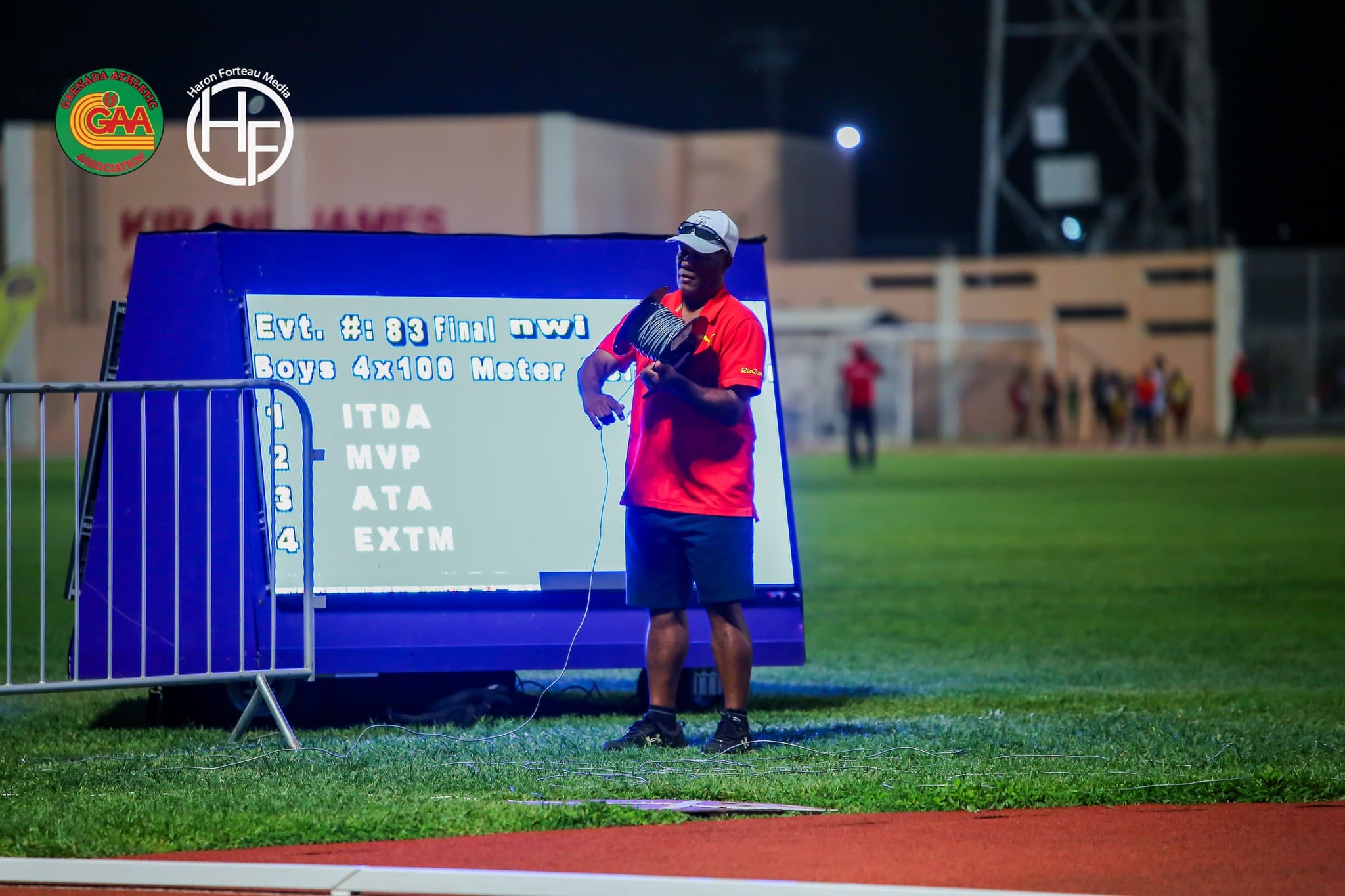
His passion for institutional development inevitably drove him toward the technical side of the sport. Joseph’s journey into fully automatic timing (FAT) began 26 years ago when Grenada hosted the 2000 CARIFTA Games.
“I started photo-finish in 2000, learning from the Finish Lynx agent that was sent to do photo finish at the 2000 CARIFTA Games in Grenada. His name is Frank Monsalve,” Joseph recalled. “At that CARIFTA, he taught me the basics of operating the software, and I had some consistent practice after that till 2004, when the hurricane destroyed the stadium and damaged the cameras.” That climate disaster plunged local track administration into a dark age. “For 12 years, we did not have photo finish.”
When the technology finally returned for the 2016 CARIFTA Games, Joseph anchored its revival. He worked initially as the backup alongside Cleon Fowler, who had historically managed the timing systems for regional CARIFTA meets, before Joseph took full command of the local infrastructure. “Since 2016, I’ve been the Chief Photo Finish Judge here in Grenada.”
True to his philosophy of longevity, Joseph has spent recent years ensuring the system can survive without him by training the next generation. “I taught my son, Obadele (OBJ), to do photo finish around 2022, and he has done it since then, with me helping now and again.”
This division of labour was on full display at the most recent CARIFTA Games, showcasing a complete overhaul of the administrative table.
“My role now is mainly to set up the cameras and make sure they are aligned and working, and if there are any problems during a meet, I troubleshoot and try to fix the problem,” said Joseph. “As for Meet Manager at this CARIFTA, OBJ did photo finish, and I did the registration of teams and oversaw the operation of the Meet Manager software. Before, Jeanelle Gill [former Secretary of the Grenada Athletics Association] was the one who operated the Meet Manager software as chief registrar, and I did the photo finish.”
Phasing out the stopwatches
This systematic modernisation required Joseph to dismantle decades of traditional administrative habits, specifically, transitioning local track and field away from manual hand-timing.
Reflecting on the difficulty of the transition, Joseph said, “In my opinion, it wasn’t very hard. In the beginning, there was some dissent from the judges and timekeepers from grapevine talk. Around 2016, they were used as backup and gradually phased out from the meets at the stadium.”
While manual timing has been systematically cleared from the national stadium to match elite World Athletics standards, Joseph recognises that it has been maintained as a developmental tool in rural areas.
“We have been doing photo finish in various parishes around the island, and at those meets, there are timekeepers and judges still, but not at the stadium anymore. This reduces the number of officials needed for a track meet, and it is faster with less chance of mistakes in the results.”
Life beyond the stopwatch and a legacy of local belief
Away from the intense pressure of cameras, registration software, and training blocks, the Gouyave native maintains a deeply rooted connection to local recreation.
“I love to play cricket and volleyball,” he said with a smile. “So off-track, I will say playing cricket in the Carriacou Masters (over 40) tournament and sweating on a Sunday evening with the volleyballers at the Carenage Court or La Borie Court has been very rewarding for me.”
When pressed to distill more than 30 years of public and athletic service into a single-sentence summary, Joseph flatly rejects the premise. “I don’t think that one sentence can answer that question, so I will make a couple,” he insists.
For Joseph, his enduring legacy is about breaking a psychological dependency on foreign expertise and establishing concrete local systems. He breaks his career contribution down into 3 distinct pillars:
As Albert Joseph prepares to clock out of his public service role for the final time this October, his supervisors reflect on a career defined by absolute reliability.
“Albert’s work ethic has always been defined by discipline, consistency, humility, and excellence,” concluded Peters. “As he prepares for his retirement this October, Albert leaves behind more than medals and championships. He leaves a lasting legacy of transformed lives, stronger sporting institutions, and a culture of excellence that will continue to inspire future generations of athletes, coaches, and public servants. His contribution to Grenada’s education system, athletics programme, and public service is immeasurable.”



Comments
No comments yet. Be the first to share your thoughts.