
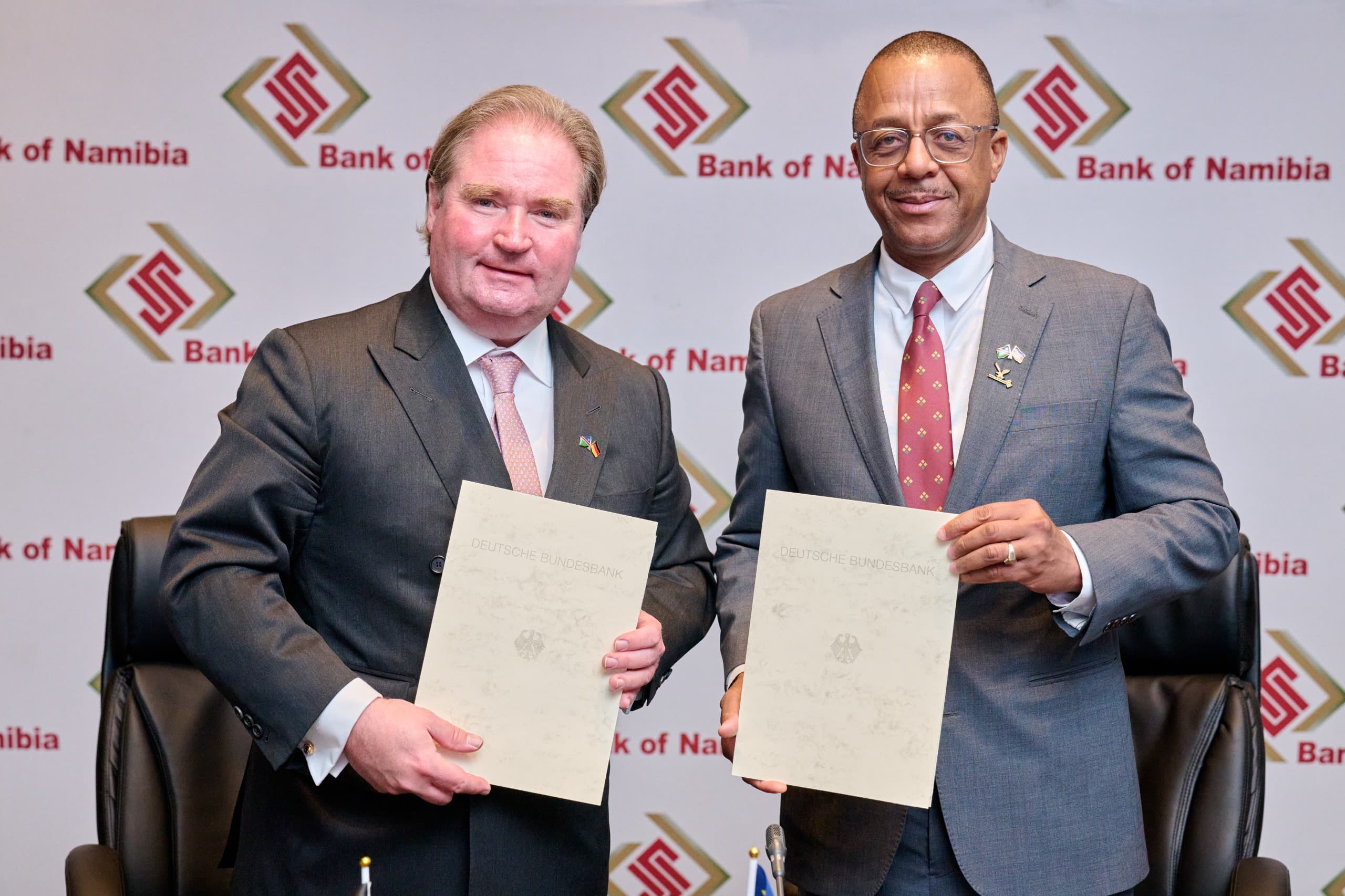
The Bank of Namibia and the Deutsche Bundesbank have reaffirmed their longstanding commitment to institutional cooperation by renewing a Memorandum of Understanding (MoU) on Technical Central Bank Cooperation.
The agreement, signed by the Governor of the Bank of Namibia, Ebson Uanguta, and Deutsche Bundesbank Executive Board Member, Lutz Lienenkämper, during the latter’s official visit to Namibia last week, marks an important milestone in a partnership that has contributed significantly to strengthening technical expertise, professional development and institutional capacity across key areas of central banking.
The renewed MoU provides a framework for continued collaboration through technical assistance, specialised training, seminars, workshops, expert discussions and study visits.
It also creates opportunities for both institutions to deepen their engagement on emerging central banking priorities, ensuring that the partnership remains responsive to an increasingly complex and evolving financial landscape.
The partnership between the Bank of Namibia and the Deutsche Bundesbank dates back to 2011, when the two institutions first formalised their cooperation.
Subsequent renewals of the MoU in 2016 and 2022 have provided continuity and expanded opportunities for collaboration.
Over the years, the relationship has evolved beyond high-level institutional engagements into a practical and results-oriented partnership, delivering meaningful benefits through technical cooperation, knowledge exchange, and human-capital development.
Among the partnership’s notable achievements is the admission of five Namibian students to the Deutsche Bundesbank University of Applied Sciences in Hachenburg, where they are receiving specialised academic and practical training in central banking.
This initiative represents a significant investment in developing the next generation of central banking professionals and building the specialised expertise required to support Namibia’s evolving financial sector.
The partnership has also delivered tangible benefits through bilateral cooperation under the European System of Central Banking (ESCB) – Africa capacity-building programme, including expert missions, technical assistance and study visits in areas such as financial stability, macroprudential oversight, sustainability and, more recently, reserves management.
These initiatives underscore the partnership’s practical value in transferring specialised expertise, strengthening institutional capacity, and supporting the Bank of Namibia’s continued development as a forward-looking, knowledge-based central bank.
The MoU renewal builds on more than a decade of substantive cooperation and reflects a shared commitment to translating international partnerships into lasting institutional value.
As central banks navigate emerging challenges and opportunities, including technological innovation and evolving financial risks, the Bank of Namibia remains committed to drawing on international expertise, strengthening its human capital, and advancing its vision of becoming a knowledge-based central bank in support of a sound, resilient, and stable financial system.
In addition to renewing the MoU, Lienenkämper participated in a series of high-level engagements to deepen institutional relations and foster knowledge exchange.
These included discussions with the Bank of Namibia’s Management Committee, where he shared insights on central banking operations and institutional best practices, as well as courtesy engagements with the Minister of Finance, Ericah Shafudah, and the newly appointed German Ambassador to Namibia, Ambassador Thomas Wimmer.
The visit concluded with a public lecture on “Institutional Excellence and Human Capital”, delivered by Lienenkämper to an audience of human resources professionals and Bank of Namibia staff, highlighting the importance of human-capital development in building strong and effective institutions.
–newsroom@nepc.com.na


Comments
No comments yet. Be the first to share your thoughts.