
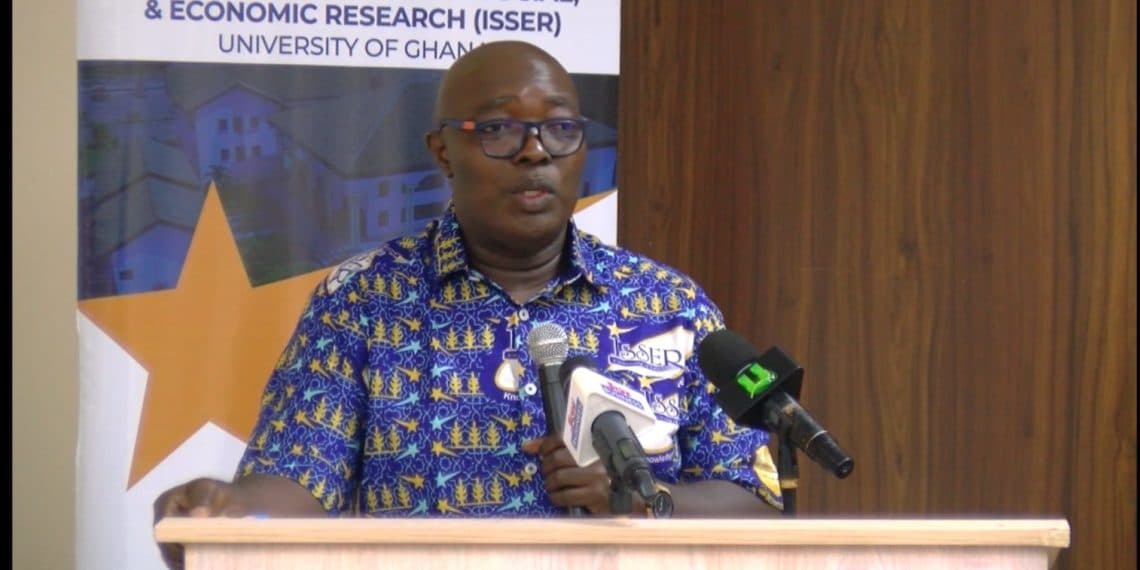
Ghana must widen its tax net and improve domestic revenue mobilisation to fund its development priorities, the Institute of Statistical, Social and Economic Research (ISSER) has warned.
The institute says the country’s tax revenue remains below the sub-Saharan African average, leaving the government with limited room to finance infrastructure, create jobs and support economic expansion without resorting to further spending cuts or other fiscal measures.
The warning features in ISSER’s State of the Ghanaian Economy Report 2025, presented by the institute’s Director, Professor Robert Darko Osei, at its launch.
Professor Osei said Ghana’s tax revenue stood at about 30 per cent of Gross Domestic Product (GDP) in 2025, highlighting a gap in the country’s ability to convert economic activity into public revenue.
“Our revenue effort is a bit low. In fact, tax revenue is under 30% in 2025, was about 30% of GDP, and that was significantly lower than that which pertains in sub-Saharan Africa,” Professor Osei said.
He said the figures pointed to the need to bring more individuals and businesses into the tax system rather than repeatedly increasing the burden on taxpayers already within the formal sector.
“What it then points to is the need for bringing more into the tax net as it were, so that the revenue effort can be improved,” he said.
The report’s findings raise questions about whether Ghana can generate enough domestic revenue to meet its growing expenditure and investment needs as the economy recovers and the government seeks to sustain recent fiscal improvements.
Professor Osei also drew attention to the implications of the country’s planned economic rebasing. Since the tax-to-GDP ratio compares tax collections with the measured size of the economy, a larger GDP estimate could reduce the ratio unless revenue collection rises accordingly.
He said Ghana’s improved fiscal position in 2025 was not driven by a substantial increase in revenue mobilisation. Revenue and grants remained broadly stable relative to GDP, while expenditure restraint accounted for much of the adjustment.
That approach may help restore fiscal discipline, but the institute’s assessment suggests that controlling expenditure alone will not resolve the longer-term challenge of financing development.
Professor Osei also pointed to Ghana’s relatively high average tariff rates compared with other countries in the sub-region, arguing that the country needed to expand its domestic tax base.
“However the average tariff rates in Ghana is significantly higher than that in the sub-region what it then points to is the need for bringing more into the tax net as it were so that the revenue effort can be improved,” he said.
Broadening the tax base would require improving compliance and bringing more economic activity into the tax system, while ensuring that revenue measures do not place a disproportionate burden on businesses and individuals who already pay taxes.
The issue is significant as Ghana seeks to consolidate its fiscal gains and create room for investment in public services and economic development. A stronger revenue base would give the government greater capacity to finance its priorities without relying excessively on expenditure cuts or additional borrowing.
ISSER’s assessment points to a central challenge for the next phase of Ghana’s recovery: sustaining economic growth while generating enough domestic revenue to support the country’s development ambitions.



Comments
No comments yet. Be the first to share your thoughts.