
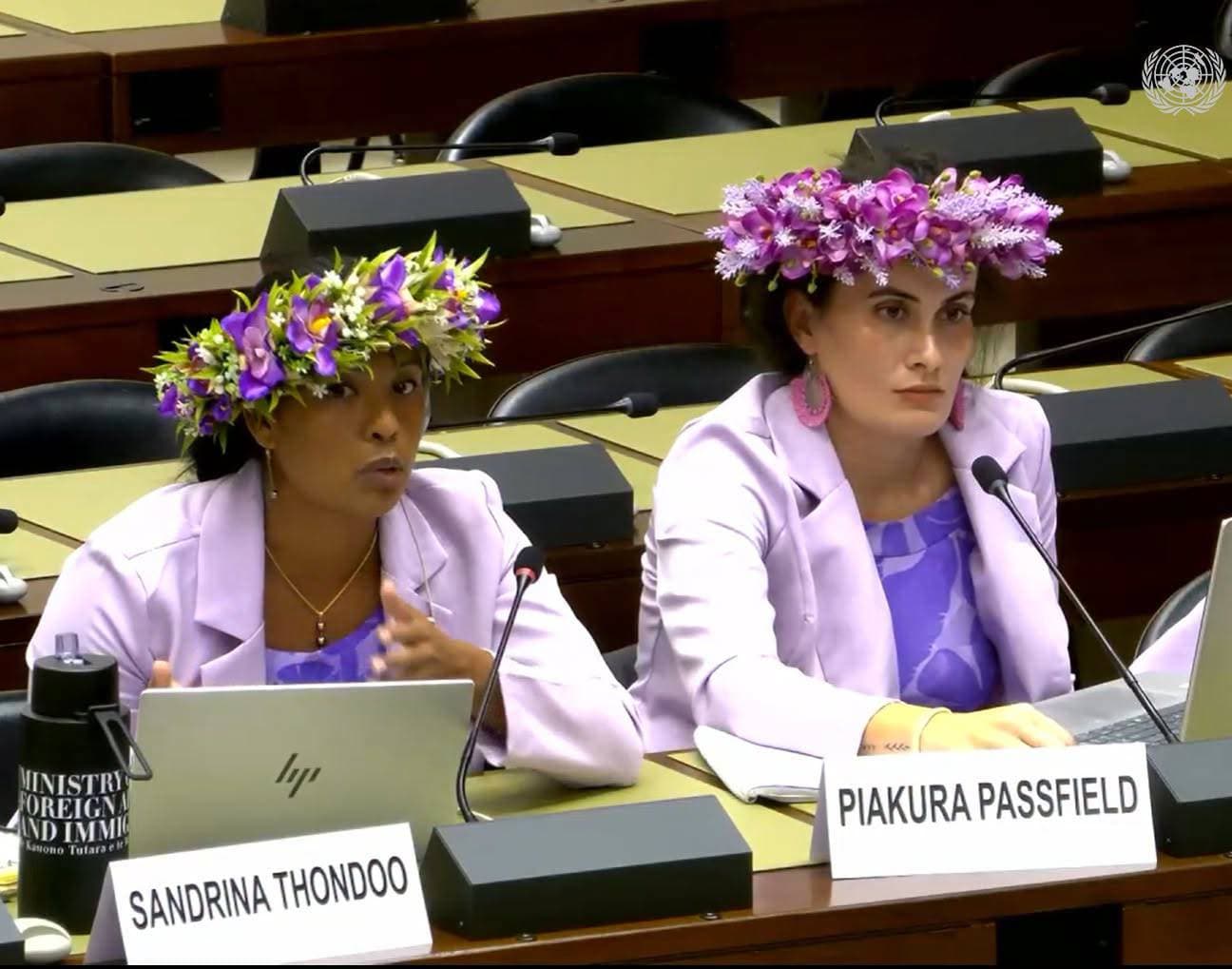
Having reviewed the Cook Islands’ progress on gender equality and its implementation of the Convention on the Elimination of All Forms of Discrimination against Women, the Committee on the Elimination of Discrimination against Women (CEDAW) raised concerns about lingering patriarchal stereotypes and specifically questioned the country’s minimum marriage age laws.
The Cook Islands delegation, which included representatives from the Ministry of Internal Affairs (INTAFF), the Ministry of Foreign Affairs and Immigration (MFAI), Crown Law and Te Marae Ora Ministry of Health, appeared before the Committee earlier this month in Geneva.
While CEDAW, the United Nations body of 23 independent human rights experts that monitors how countries implement the Convention, welcomed the country’s efforts, it considered these issues during its review of the Cook Islands’ combined fourth and fifth periodic reports on October 7.
Grace Chynoweth-Maurangi, Secretary for INTAFF and head of the Cook Islands delegation, informed the Committee that the nation’s population of approximately 15,000 is dispersed across 15 islands, creating significant challenges in connectivity, coordination and equitable access to services.
Chynoweth-Maurangi emphasised that these challenges are not experienced equally by all women or the population as a whole.
She noted that Rarotonga is home to the majority of the population and serves as the centre of government administration, offering better health, social, legal, education and support services.
In contrast, residents of the Pa Enua (outer islands) face geographical isolation, limited and costly transport options, and a shortage of specialist services.
“Formal equality in national law and policy must ultimately translate into effective and equitable access for every woman, regardless of the island on which she lives,” Chynoweth-Maurangi said.
“Our geography and limited capacity do not lessen our obligations under the Convention. Rather, they shape the practical solutions we must develop to ensure that women in the Pa Enua are not left behind.”
She noted that when geographic isolation intersects with gender-specific issues, the risks compound, particularly for survivors of abuse or those seeking sensitive care.
“For women experiencing violence or seeking sensitive health, social or legal support, the realities of very small communities create an additional challenge: privacy and confidentiality can be more difficult to maintain when people know one another, and services are delivered by only a handful of individuals.”
Chynoweth-Maurangi added that for some women seeking assistance, accessing specialised support could mean approaching someone they know personally or travelling away from their home island.
She urged the CEDAW experts to consider this “important lens” when evaluating the Cook Islands’ implementation of the Convention.
CEDAW concerns
During the session, CEDAW experts pressed the Cook Islands delegation on its timeline for raising the legal minimum age of marriage to 18 for both men and women without exception. The Committee requested data on child marriages and urged the government to establish systematic, ethical procedures for collecting these statistics.
In response, the delegation acknowledged that under the current Marriage Act, both males and females can legally marry at 16, though they noted that the legislation is currently under review.
Experts also questioned what specific steps are being taken to dismantle traditional norms that perpetuate domestic gender inequality, inquiring when the review of the Matrimonial Property Act would wrap up and how it will secure women’s rights regarding property, inheritance and financial stability.
The delegation stated that while the process is delayed by complex legal elements, the broader legislative review will unfold over the next year. A review of the Matrimonial Property Act will also take place – “the latter, however, would be piecemeal as it was very complex. De facto relationships would be recognised under the act”.
While acknowledging progress made under the Family Protection and Support Act, the Committee pointed out that its implementation plan has remained in draft form since 2019.
Experts asked whether the plan would be formally adopted and fully resourced, and whether the government would consider extending free legal aid to cover protection orders, divorce, custody, maintenance and matrimonial property cases – particularly for women in vulnerable situations and in the Pa Enua.
Additionally, experts pressed for legislative reforms to eliminate substitute decision-making, allowing women with intellectual or psychosocial disabilities to make autonomous choices regarding marriage and family life with appropriate support.
Addressing domestic labour and property rights, the delegation noted that for domestic work, “the act recognised non-monetary contributions when the courts were determining how to divide property”, adding that “inheritance was not gender-based; it was customarily equal and based on blood and family”.
Regarding legal representation, officials explained that “legal aid as a concept was usually viewed as being for criminal offenders, but its extension to women in divorce proceedings would be considered.” They added that “in terms of disputes and informal pressure placed on victims, there was no data on this. Mediation was being examined by lawyers and the judiciary, and could perhaps be concretely put into legislation to remove the burden of going to court.”
Acknowledging gaps in protection for women with disabilities, including psychosocial disabilities, the delegation recognised this as a statutory oversight. They explained that while judges can appoint an amicus curiae to assist such individuals, enforcement remains constrained by a shortage of personnel.
A CEDAW expert emphasised that the Committee was not challenging customary or territorial rights, but rather advocating for the explicit inclusion of women’s and girls’ rights, noting that recognising the economic value of unpaid domestic and care work benefits both families and the broader economy.
The expert also voiced deep concern over vulnerable women and victims of domestic abuse who are blocked from seeking justice due to a lack of legal representation.
Experts noted the critical lack of shelters for domestic violence victims, asking whether dedicated safe havens would be established and what future measures would be taken to move beyond informal family dispute resolution to better protect survivors’ rights.
The delegation explained that establishing permanent shelters remains difficult due to severe financial constraints. However, the government’s objective is to secure temporary safe accommodation in local hotels equipped with 24-hour security.
“There are already provisions in law to ensure that perpetrators leave the shared premises so that the survivor can remain there,” the delegation stated.
They added that in the Pa Enua (outer islands), police officers have the authority to issue immediate safety orders requiring perpetrators to vacate the property.
“In terms of mediation within the family, the Gender-Based Unit had been raising awareness of domestic violence and the rights of survivors, and had noticed that in a lot of cases communities understood domestic violence as physical, but not as psychological or economic. It was key to make survivors understand their rights and to give them the mechanisms for taking the case forwards.”
Turning to deep-seated patriarchal stereotypes, Committee members asked what concrete actions, resources and accountability measures exist to eliminate gender bias across schools, churches, the media and social platforms following the passage of the Cybercrime Act.
Experts also questioned when case management guidelines for gender-based violence would be formally adopted, when health workers would be trained in post-rape care and what steps were being taken to ensure proper referrals and access to justice. The Committee inquired about the training provided to relevant authorities and asked what plans exist to prevent surges in gender-based violence during national emergencies. They requested details on how the government intends to ensure that national gender plans are fully resourced and financed.
The delegation highlighted ongoing initiatives, including parenting workshops designed to challenge gender stereotypes early in life, an action framework that engages men, boys, churches, schools and media, and explicit monitoring protocols embedded in the national gender policy.
Experts further inquired whether the Cook Islands plans to introduce a standalone anti-discrimination clause covering intersectional discrimination –including disability – aligned with CEDAW standards, and whether the government will use its submissions to the International Court of Justice (ICJ) to harmonise domestic laws with international human rights treaties.
The delegation affirmed its commitment to its ICJ presentation, explaining that it currently addresses treaty alignment on a legislation-by-legislation basis with the long-term goal of drafting comprehensive standalone legislation.
“The Cook Islands was also currently reviewing legislation to ensure that it was compliant with anti-money-laundering rules, and would continue to address this. On a review of all rights in line with the Convention, the Law Commission had been reinstated and was examining this question, and would be conducting international obligations assessments on all treaties.”
The experts also asked whether the government intends to establish a standalone ministry or inter-ministerial body for gender equality, what portion of the national budget goes to gender initiatives, whether a post-2024 gender policy has been endorsed and if quotas or reserved seats for women on island councils are being considered under reviews of the Electoral and Island Government Acts.
The delegation responded that the government has not dismissed proposals from the National Council of Women, but is carefully weighing structural constraints and limited personnel before deciding whether a new body is practical.
“There was concern that there may be a lack of persons specialised in gender issues. The question was to weigh out what was more sustainable and worked, given the challenges stated previously. Thus, whether to create a new body or whether to strengthen already-existing elements was an issue that was still under consideration.”
Regarding direct budget allocations, officials admitted: “When it came to gender, unfortunately it was unclear what went to gender issues, but each Ministry used its budget to deliver gender-related programmes.”
On national policy and political representation, the delegation confirmed that a first draft of the updated gender policy was received this month, though no timeline for formal endorsement exists. Addressing temporary special measures, officials stated there are currently no quotas for women in Parliament or local councils, as the nation favours mentorship and training to help women enter office on their own merit.
Experts questioned how existing systems identify and prevent human trafficking, what protections exist for migrant workers, and whether data is available regarding sex work and the prosecution of sexual exploiters.
The panel also asked whether Cook Islands law adequately criminalises child prostitution and child sexual abuse material, and when legal reforms will address these gaps while fully decriminalising sex workers.
In response, the delegation acknowledged that the last study on human trafficking, sex tourism and prostitution was conducted in 2007, with no updated data collected since.
Delegates noted that prostitution itself is not illegal when conducted in private. Regarding child exploitation and abuse material, officials pointed to the new Cybercrimes Act, which establishes penalties to criminalise these offences and related acts.
The Committee experts inquired about the specific measures being taken to ensure that women in the Pa Enua have equal, practical access to nationality and residency documentation, as well as essential administrative services. The panel questioned whether simplified procedures, mobile registration units, or digital solutions were available so that geographic isolation does not serve as a barrier to women exercising their rights. Additionally, experts asked how the Cook Islands ensures that all women, including migrant and married women, have equal access to nationality and residency paperwork, as well as the documentation required to access employment.
In response, the Cook Islands delegation stated that the law makes no distinction between women and men, and that all citizens are treated equally under the existing framework.
“On issuing residency status, requirements were gender-neutral; the criteria applied were the number of years and other conditions to qualify for permanent residence. On how women could obtain documentation, marriage was irrelevant, as there was identical access to paperwork. All paperwork could be done from the Pa Enua, and where necessary there was transportation for documents to the main island. On New Zealand citizenship, this fell outside the remit of the Cook Islands Government.”
Cook Islands delegation outlined efforts to promote women-led businesses and female entrepreneurs, highlighting initiatives that create dedicated spaces for women, including those in the outer islands of Pa Enua, to sell crafts and natural products as a primary source of income.
Addressing female economic participation, officials revealed that guidelines regarding women and childcare are currently under development. The government is also considering a childcare subsidy aimed at providing mothers with affordable care options to facilitate their return to the workforce.
Regarding major infrastructure and investment projects, the delegation noted that the Asian Development Bank enforces social and environmental policy safeguards. These policies apply across numerous national development projects, ensuring women are actively included and that their specific needs and perspectives are reflected.
Experts inquired about the timeline and legal framework for implementing equal pay for equal work, mandatory pay audits and gender-neutral job evaluations under the National Employment Policy 2026–2031. They also pressed the delegation on measures to introduce pension credits for unpaid caregiving, strengthen protections against workplace sexual harassment and gender-based violence, and establish accessible, secure reporting channels for victims.
The delegation highlighted financial literacy, bookkeeping and business startup training programmes, including approximately 10 workshops conducted across the Pa Enua. While training is available, officials noted that uptake ultimately depends on individual participation.
Addressing workplace discrimination and pay disparities, officials acknowledged that the country’s small total workforce remains a structural challenge.
“However, there were inspections that took place, and recommendations were given to employers, but the latter then needed to make their own changes to ensure that women were treated equally in the workforce. There was a Workplace Health and Safety Bill, which would give the inspectors more power to enforce changes when they recognised issues.”
Inspectors also conduct outreach regarding sexual harassment and labour rights. However, privacy concerns in small communities often prevent victims from filing formal grievances, restricting government intervention.
In response, CEDAW experts urged the government to implement a more victim-friendly reporting framework, reminding officials that Article 2 of the Convention obligates states to actively eliminate discrimination.
When experts asked whether shifts in female education patterns had successfully opened up traditionally male-dominated sectors, the delegation acknowledged that a pronounced gap remains, though they expressed confidence that female representation in these fields will steadily increase over time.
Government commitment
Chynoweth-Maurangi stated that the Cook Islands government remains committed to advancing female representation.
She highlighted strong gains in education and senior public sector roles, where women currently make up 73 per cent of school principals, 50 per cent of ministry heads, 42.9 per cent of board directors and 20 per cent of Crown entity chief executives.
However, she noted that progress remains uneven, pointing out that women’s representation in Parliament declined from 29 per cent in 2022 to 25 per cent in 2026.
On economic security and family support, Chynoweth-Maurangi said the country has strengthened maternity and paternity leave laws, increasing maternity to 14 weeks by 2029 and paternity leave to two paid weeks under the Employment Relations Amendment Act 2026.
The Act covers protections to foreign workers and adoption.
She highlighted that the Government Paid Maternity and Paternity Leave Policy 2026 provides paid paternity leave for eligible private-sector employees and encourages workplace support for parents. Labour inspections will now focus on pregnancy and maternity discrimination. However, self-employed, informal, and casual workers are not yet fully covered, and ensuring these protections reach all women remains a challenge.
A dedicated Gender-Based Violence Unit within the INTAFF, providing stronger national coordination and policy development helped develop the National Gender-Based Violence Policy and Action Plan 2026-2031, she said.
This is pending government approval due to election-related delays but the Unit has already improved collaboration among key agencies to better address gender-based violence, she said.
In reaching out to the Pa Enua and migrant women, she said Patient Referral Policy 2026 that was effective from July this year assists in additional costs faced by people living outside Rarotonga.
“Pa Enua patients referred to Rarotonga are now eligible for an accommodation subsidy, and family escort arrangements have been broadened in specified circumstances.
“The policy also expanded access for contract expatriate workers. A contract worker who has completed at least six months of continuous employment in the Cook Islands can now come within the referral framework, subject to the applicable clinical and referral criteria. Together with the extension of maternity and paternity protections to foreign workers, this is an important step in reducing differences in protection based simply on nationality or immigration status.”
Additionally, the new Sexual and Reproductive Health Policy aims to improve access to health services and information across all islands, with support from the Cook Islands Family Welfare Association.
CEDAW Committee chairperson Nahla Haidar acknowledged the nation’s resource limitations and commended the delegation’s ongoing efforts.
Chynoweth-Maurangi thanked the panel for their insights, noting that the dialogue provided valuable lessons for future policy implementation.
(Source: United Nations Information Service in Geneva)

Comments
No comments yet. Be the first to share your thoughts.