
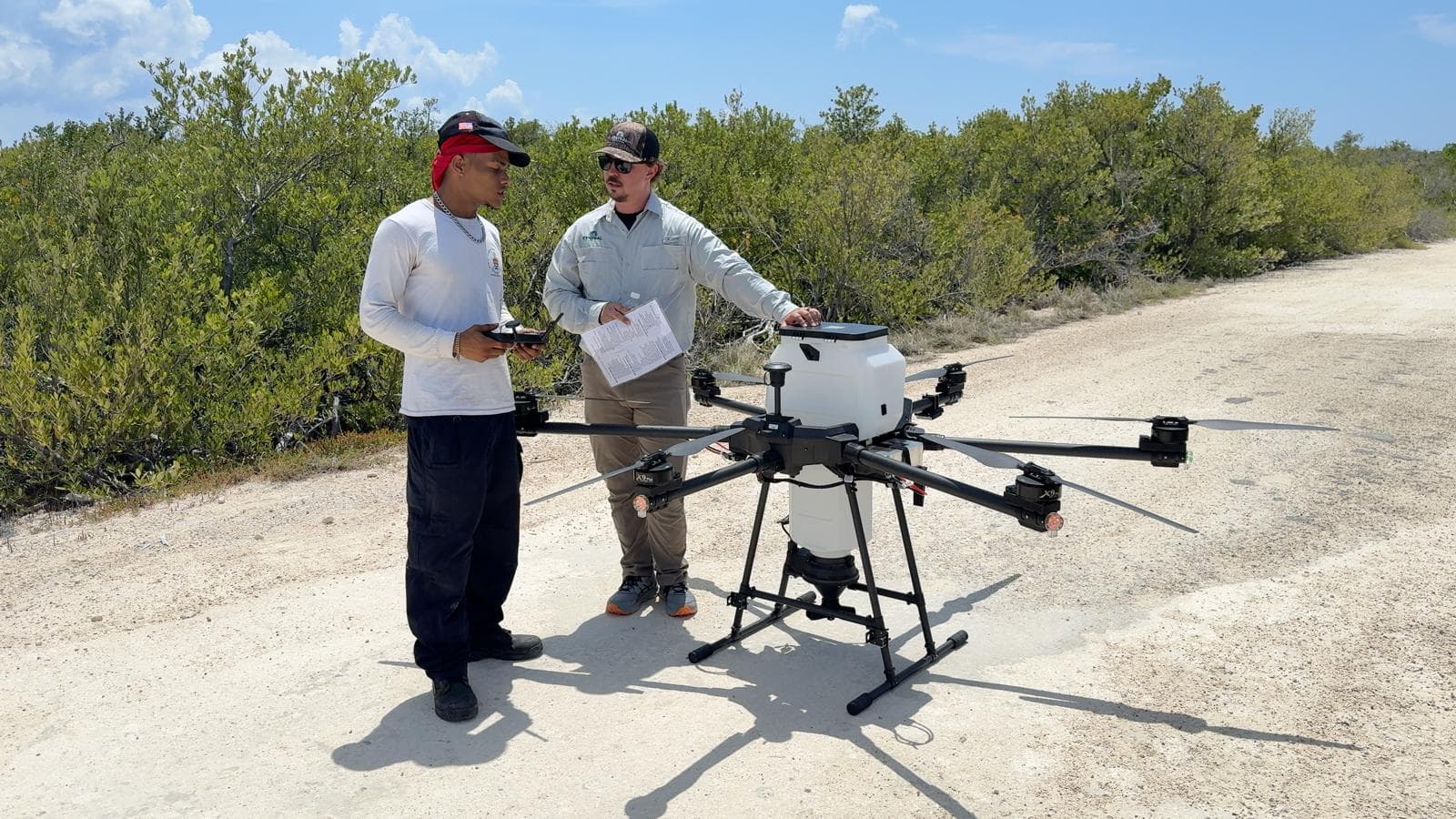
The Mosquito Research and Control Unit’s two PrecisionVision 40X application drones were damaged in separate incidents in May and July, Deputy Director of Research and Ground Operations Kris New told the Compass.
The revelation comes as the unit is also grappling with problems affecting its ageing fixed-wing aircraft fleet, while government has announced another $1.8 million to purchase a second replacement plane.
The first drone accident occurred on 5 May during a controlled swath-testing exercise.
“As the drone was returning to land, it drifted during descent and struck the ground,” New said.
The cause was reviewed but could not be conclusively determined.
The second incident occurred in July during controlled testing of a liquid larvicide application system. During the test, the drone descended from a low altitude and sustained damage.
“Following that incident, MRCU reviewed and strengthened its procedures relating to payload calculation, loading and testing,” New said.
Neither incident resulted in injury or damage to third-party property, and both occurred within controlled operational areas.
The two PrecisionVision aircraft were MRCU’s application drones, but the unit has other small drones which were not involved in the accidents and remain in use.
Both damaged aircraft were insured.
MRCU is now progressing the replacement of one with a DJI Agras T50 application drone. New said it will not enter operational service until the required procurement, regulatory approval, training and competency processes have been completed.
The application drones were introduced as an additional tool capable of treating relatively small or difficult-to-access mosquito breeding areas that can be impractical for conventional aircraft or ground crews.
In August, New said the programme had treated around 400 acres.
Meanwhile, government is moving to replace both of MRCU’s 20-year-old fixed-wing aircraft.
Health, Environment and Sustainability Minister Katherine Ebanks-Wilks told parliament on 1 Oct. that an additional $1.8 million had been identified to purchase a second replacement aircraft concurrently with one already approved in the 2026-2027 budget.
“MRCU currently operates two aging aircraft, both of which are experiencing increasing periods of downtime due to ongoing maintenance and repair requirements,” she said.
The funding will come through a corresponding $1.8 million reduction in the Infrastructure Development Fund.
The announcement follows a Compass report on 30 Sept. that one existing aircraft had developed a mechanical problem while the remaining plane was approaching a mandatory 100-hour inspection.
Ebanks-Wilks also indicated that the first new aircraft could arrive considerably sooner than MRCU had previously suggested.
Watler told the Compass on 29 Sept. that the replacement was at least a year away, although expected within two years.
But responding to a question in Parliament from opposition MP Roy McTaggart about leasing an aircraft in the interim, Ebanks-Wilks said a leased aircraft would not be available until December, while the new aircraft was “hoped to be ready somewhere in the early part” of 2027.
The equipment difficulties come at a challenging time for MRCU, with heavy rainfall and elevated tides flooding extensive mosquito breeding habitat, and the unit warning that a significant increase in adult mosquito numbers is expected.



Comments
No comments yet. Be the first to share your thoughts.