
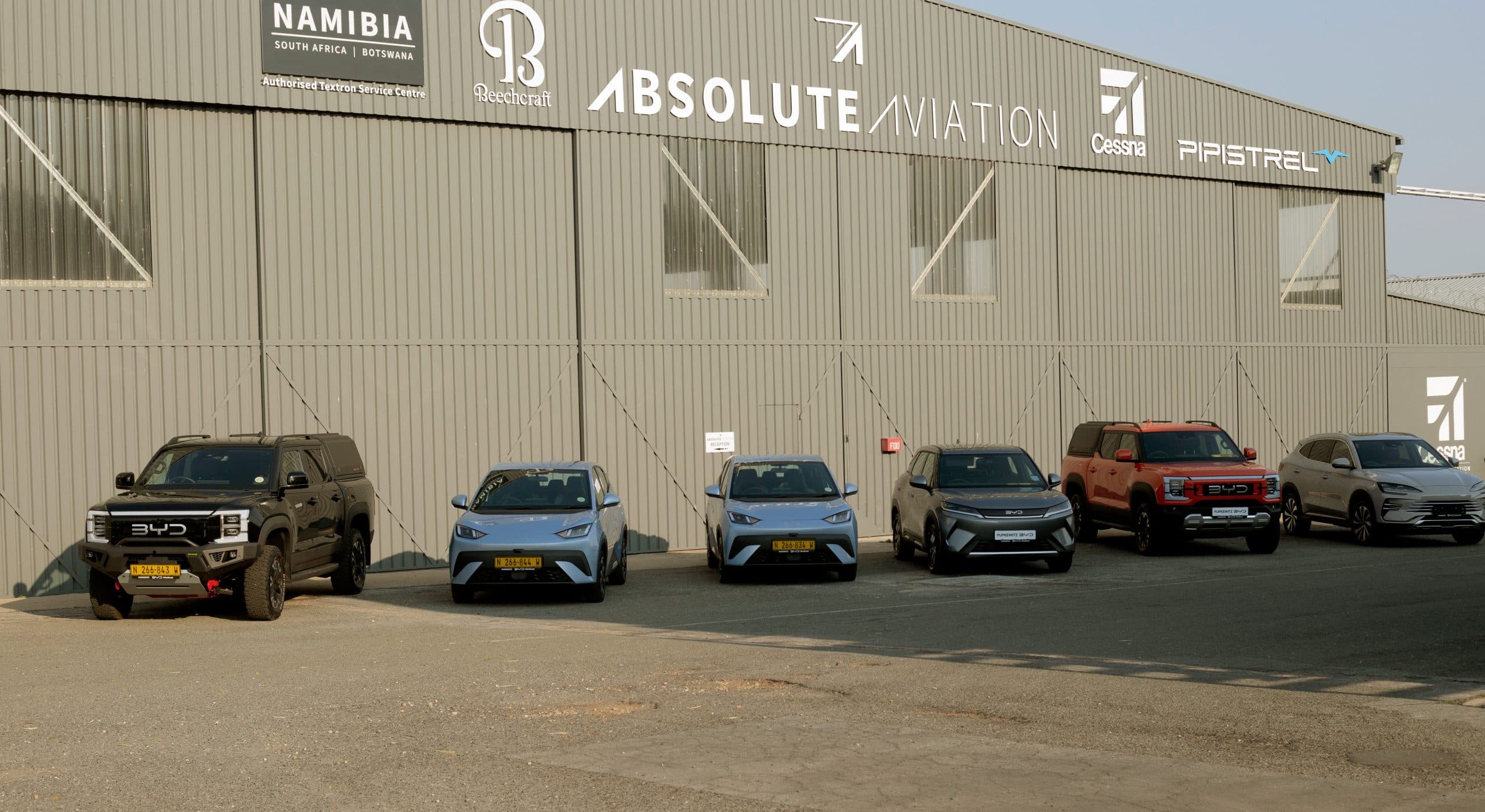
Namibia’s automotive market has entered a new phase with the arrival of Chinese new-energy vehicle giant BYD, as the global manufacturer seeks to translate its rapid international expansion into a foothold in one of Africa’s emerging automotive markets. BYD was officially launched in Namibia on 1 October 2026, with Pupkewitz Motors appointed to represent the brand locally and establish dedicated retail and customer touchpoints in Windhoek, Walvis Bay and Ongwediva.
The BYD arrival gives local motorists access to a substantially broader range of electric and electrified vehicles at a time when the local market is gradually looking for alternative powertrains.
The move is particularly significant because BYD is no longer simply an electric-vehicle challenger. The company has built itself into one of the world’s major new-energy vehicle manufacturers, with ambitions to expand a global footprint and challenge established automotive brands across increasingly diverse markets.
Domestically, that global scale potentially gives consumers access to technology and vehicle choices that were previously largely unavailable in the local market.
Pupkewitz Motors Franchise Executive Nico Pieters said the company’s ambition extends beyond simply adding another badge to its portfolio.
“Today marks a significant milestone as we officially welcome BYD to Namibia. We are excited to introduce Namibians to a brand that has placed innovation and new energy mobility at the centre of its global strategy,” said Pieters. “Our ambition is not simply to introduce new vehicles to the market, but to create an experience around new energy mobility that is relevant to Namibian customers.”
BYD’s Namibian line-up includes the Dolphin, Dolphin Surf, Sealion 5, Sealion 6, Shark 6, Sealion 7 and Seal Performance, giving the distributor a broad spread across passenger and utility-oriented segments.
The Shark 6 is arguably the most strategically significant model for Namibia, where bakkies occupy a central position in both private and commercial motoring.
The vehicle combines pickup functionality with BYD’s new-energy technology, potentially putting electrified propulsion directly into competition with conventional diesel-powered pickups that dominate much of the domestic market. This could prove important in a country where long-distance travel, towing, off-road driving and load-carrying remain critical considerations for buyers. The broader BYD range, meanwhile, allows the brand to target motorists with different requirements, from compact urban mobility to larger SUVs and performance-oriented vehicles.
Moreover, BYD’s global strategy is centred on placing electrification at the heart of its international expansion. Its push into markets outside its traditional strongholds has also intensified competition between Chinese manufacturers and established Japanese, European and American automotive brands as Namibia is increasingly becoming part of that competitive battleground.
The local market has already seen growing interest in Chinese automotive brands, attracted in part by competitive pricing, increasingly sophisticated technology and expanding model ranges. BYD’s entry adds one of the world’s most prominent new-energy specialists to that mix.
Pieters added that Pupkewitz Motors intends to focus on consumer education as much as vehicle sales. “We look forward to building awareness, educating consumers and giving customers the opportunity to experience BYD for themselves,” he said.
That education component could be crucial in Namibia, where concerns around charging infrastructure, driving range, battery durability and vehicle resale values remain important considerations for motorists contemplating a move away from conventional internal-combustion engines.
The recent launch also comes as Namibia considers the wider implications of energy efficiency and alternative mobility, including the infrastructure required to support an expanding electric vehicle fleet.
For Pupkewitz Motors, the BYD franchise represents both an expansion of its portfolio and a bet on how domestic mobility will evolve. For consumers, however, the more immediate significance is increased choice.
With BYD now competing on Namibian soil, the country’s automotive market is no longer merely watching the global transition towards new-energy mobility from the sidelines but is becoming part of it. –ebrandt@nepc.com.na

Comments
No comments yet. Be the first to share your thoughts.