
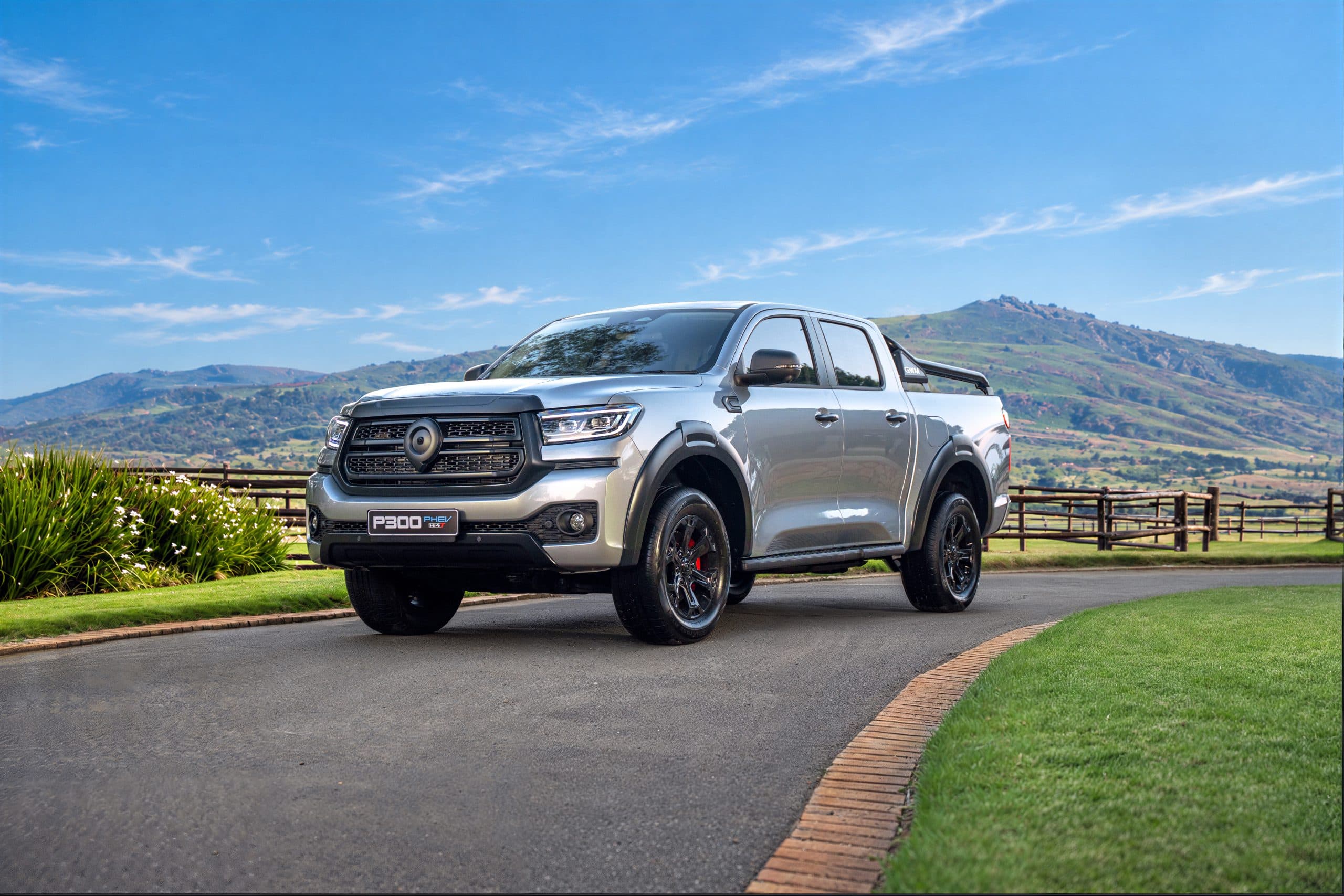
GWM has expanded its P300 range with the introduction of the new P300 2.0T Hi4-T PHEV 9HAT, the first electrified derivative in the P300 bakkie range. The plug-in hybrid expands the P300 range by pairing the practicality and capability of a GWM bakkie with electric driving.
It can complete routine journeys, such as school runs and daily commutes, on electric power alone without sacrificing the performance, all-wheel-drive ability or off-road capability required for more demanding conditions. The P300 PHEV is designed to offer a versatile solution for customers who want the efficiency and refinement of electric motoring during the week, without compromising the go-anywhere capability that makes a bakkie such a compelling choice for weekends and leisure adventures.
Powertrain and performance
The P300 PHEV pairs a hybrid-dedicated 2.0-litre turbo petrol engine, producing 180kW and 380Nm, with GWM’s nine-speed automatic transmission. Integrated into the transmission is a 130kW electric motor producing 495Nm, giving the all-wheel-drive P300 a combined system output of 310kW and 750Nm.
Unlike a conventional plug-in hybrid that may rely heavily on its electric motor when battery charge is available, the P300 PHEV’s engine and electric motor work in parallel. The electric motor delivers immediate torque at lower speeds, while the petrol engine operates within its most efficient range. This parallel-hybrid approach also helps maintain performance when the battery charge is low, with the engine continuing to drive the wheels. The P300 PHEV is designed to deliver consistent performance during long climbs and heavy-load driving conditions that would challenge conventional plug-in hybrid systems.
Equipped with three selectable power modes, the P300 PHEV allows drivers to tailor the powertrain to different driving conditions. Electric Mode prioritises quiet, zero-tailpipe-emission motoring for shorter daily journeys, while Hybrid Mode combines the petrol engine and electric motor for longer-distance and highway driving. Intelligent Mode gives drivers greater control over battery usage, allowing the state of charge to be maintained between 30% and 80%. It also incorporates Camping Mode, which reserves battery capacity for powering appliances and other electrical equipment when spending time off grid.
Electric commuting
Power comes from a 33.1kWh lithium iron phosphate (LFP) battery using short-blade laminated cells. The P300 has an electric-only range of up to 115km (NEDC), enough to cover most daily commutes without using the engine. Combined fuel consumption is rated at 2.4L/100km.
The battery supports DC fast charging at up to 110kW and can go from 30% to 80% in about 18 minutes at normal temperatures. The pack is mounted on the frame rails for protection off-road, carries an IP68 dust and water rating, and has passed a 28-day salt-spray corrosion test. The battery can also power other equipment. Vehicle-to-Load (V2L) supplies up to 6kW when parked and 4kW on the move, through two outlets. That covers camping appliances, power tools on a job site or equipment far from mains power, with no separate generator. The engine can top up the battery automatically when it runs low.
Built for more than daily commute
Underneath its electrified powertrain, the P300 PHEV remains a thoroughly capable bakkie. Its body-on-frame chassis is supported by double-wishbone front suspension and a rigid rear axle with a 3+2 leaf-spring configuration, providing the durability and load-carrying capability required for demanding work and towing duties.A part-time four-wheel-drive system offers 2H, 4H and 4L settings, with low range providing a 2.64:1 torque multiplication ratio for steep climbs, challenging terrain and difficult recoveries.
An electronically controlled rear
differential lock is fitted as standard, while selectable drive modes, an All-Terrain Feedback System, Off-Road Expert Mode and underbody protection further enhance its off-road credentials.
The P300 PHEV offers 200mm of ground clearance, together with a 26-degree approach angle, 23-degree departure angle – reduced to 21 degrees when fitted with a tow bar – and a 19-degree breakover angle. These figures give the PHEV the necessary clearance and geometry to tackle demanding trails while retaining the practicality expected of a modern double-cab bakkie. Towing capability is equally important, with a braked towing capacity of 3 500kg. A dedicated Trailer Driving Mode is designed to make towing safer and more intuitive.
“The P300 PHEV opens a new chapter for the P300 range,” says Floyd Ramabulana, Head of Marketing at GWM South Africa. “South African bakkie buyers have been clear that they won’t compromise on towing, off-road ability or durability. With Hi4-T, they don’t have to.
This is a bakkie that can commute on electricity during the week, tow 3 500kg at the weekend and power a campsite when it gets there. It gives our customers the benefits of electrification on terms that suit the way they use their vehicles.”

Comments
No comments yet. Be the first to share your thoughts.