
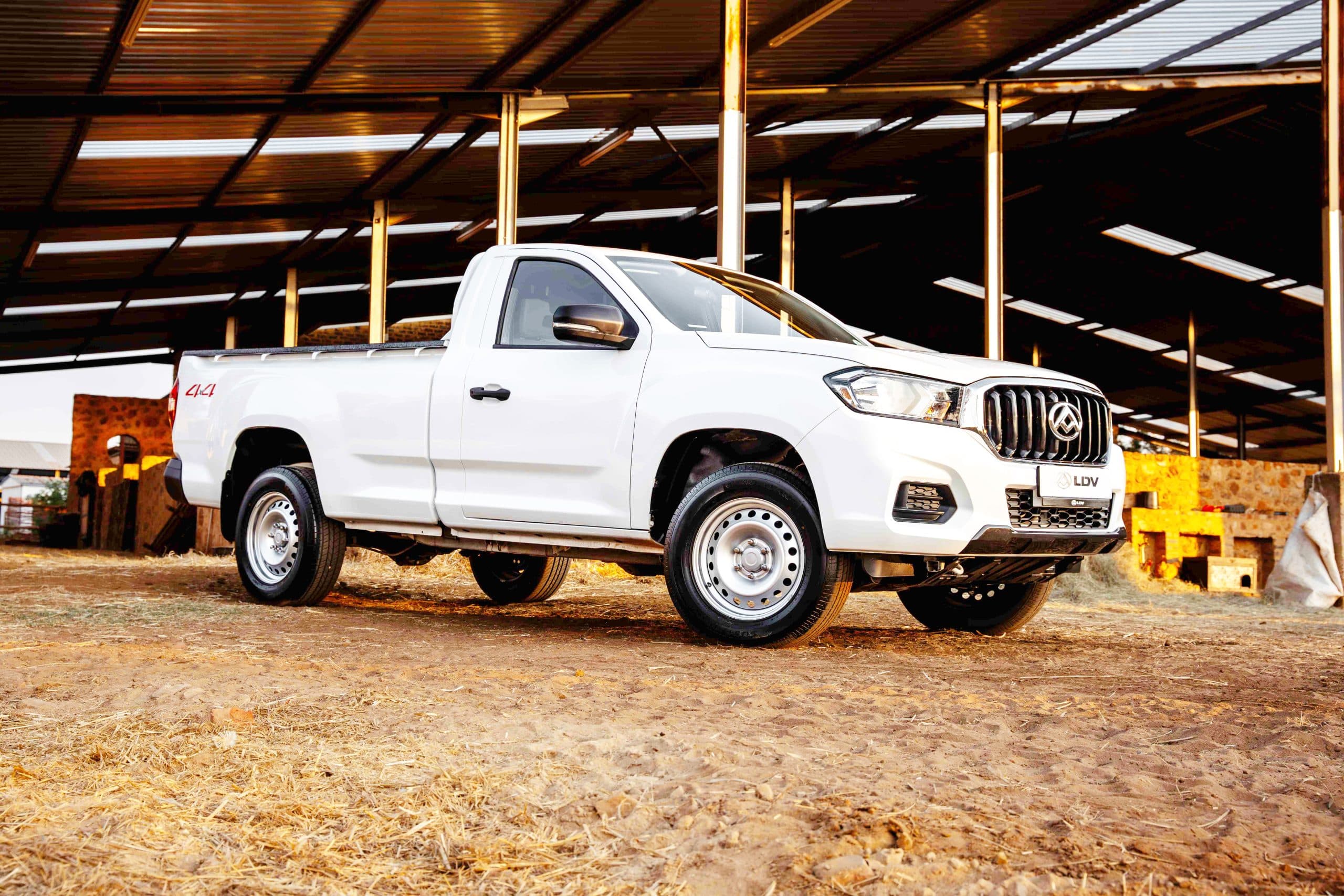
The new T60 Utility Single Cab enters a market where affordability, payload and durability remain critical considerations for businesses and fleet operators. This is as LDV stepped up its challenge to established bakkie brands in Namibia with last week Friday’s introduction of the T60 Utility Single Cab, positioning the workhorse as a value-focused option for businesses operating in agriculture, construction, mining, security, municipalities and government fleets.
Priced starting from N$299 900, the T60 Utility Single Cab is being marketed as one of the most competitively priced single-cab bakkies available to Namibian buyers at its level of specification, as LDV seeks to build on its growing presence in the local commercial vehicle market.
The launch comes as single-cab bakkies continue to occupy an important position in Namibia’s economy, particularly among small and medium-sized businesses and operators whose vehicles are primarily tools of trade rather than lifestyle products.
LDV Namibia Sales Executive Karl-Heinz Eisenberg said the introduction of the single cab strengthens the brand’s ability to cater for customers who prioritise practicality and affordability.
“The T60 Utility Single Cab is particularly well suited to the Namibian market because it gives businesses a hardworking commercial vehicle without requiring them to compromise on essential capability and modern features,” said Eisenberg.
The T60 Utility Single Cab is powered by a 2.0-litre turbo-diesel engine producing 120kW and 410Nm of torque, with power delivered through a six-speed manual transmission.
LDV noted the combination is designed to provide sufficient pulling power for applications ranging from urban deliveries to demanding off-road work sites.
For commercial operators, however, the vehicle’s payload and towing figures could be among its most significant selling points. The T60 has a payload capacity of up to 1 170kg, while its braked towing capacity is rated at 3 000kg.
A 73-litre fuel tank further extends its potential operating range, an important consideration for Namibian businesses covering long distances between towns, farms, mines and project sites.
The bakkie is available in both 4×2 and 4×4 configurations, giving fleet buyers the option of matching drivetrain capability to their operating requirements.
LDV claims and impressive fuel consumption of 7.5 litres per 100km on the highway and 8.7 litres per 100km in urban driving, although actual consumption will of course depend on load, terrain, driving conditions and operating environment.
At 5 395mm long, 1 900mm wide and 1 830mm high, with a 3 155mm wheelbase, the T60 Utility Single Cab is a substantial commercial vehicle. The dimensions also provide a relatively spacious cabin, while the vehicle has been configured to offer a balance between working capability and driver comfort.
The equipment list includes air conditioning, a Bluetooth-enabled radio and selectable Eco, Power and Normal driving modes, allowing drivers to alter the vehicle’s characteristics according to conditions and workload.
Safety equipment includes driver and front passenger airbags, anti-lock braking, Electronic Brakeforce Distribution, a differential lock, hydraulic power steering, a high-mounted brake light and rear fog lamp.
For Namibian fleet operators, the combination of a relatively low acquisition price and commercial-oriented specifications could make the T60 Utility Single Cab particularly relevant in sectors where vehicles are subjected to intensive daily use.
At last week’s launch, LDV South Africa chief executive officer Gerhard Moolman said the model was intended to strengthen the company’s position in the commercial vehicle market by combining capability, practicality and value.
“With the launch of the T60 Utility Single Cab, we’re strengthening our commitment to South Africa’s commercial vehicle market by delivering a dependable workhorse that combines capability, practicality and value for business owners and fleet operators alike,” said Moolman.
LDV’s origins can be traced to the British Leyland DAF Vans brand, while the modern LDV operation forms part of SAIC Motor, one of the world’s largest vehicle manufacturers.
The brand entered Namibia in 2024 and has subsequently expanded its local portfolio beyond the T60 Double Cab. Its current range includes the flagship Terron 9, D90 seven-seater SUV, Deliver 9 large panel van and G10 commercial vehicle.
The T60 Utility Single Cab represents more than another addition to LDV’s range. It is a direct attempt to gain ground in the traditional commercial bakkie market by putting price, load-carrying ability and working capability at the centre of the proposition.
For Namibia’s cost-conscious business sector, this formula could prove particularly significant as companies continue to seek ways of controlling fleet acquisition and operating costs without sacrificing the ability to effectively and efficiently get work done.

Comments
No comments yet. Be the first to share your thoughts.