
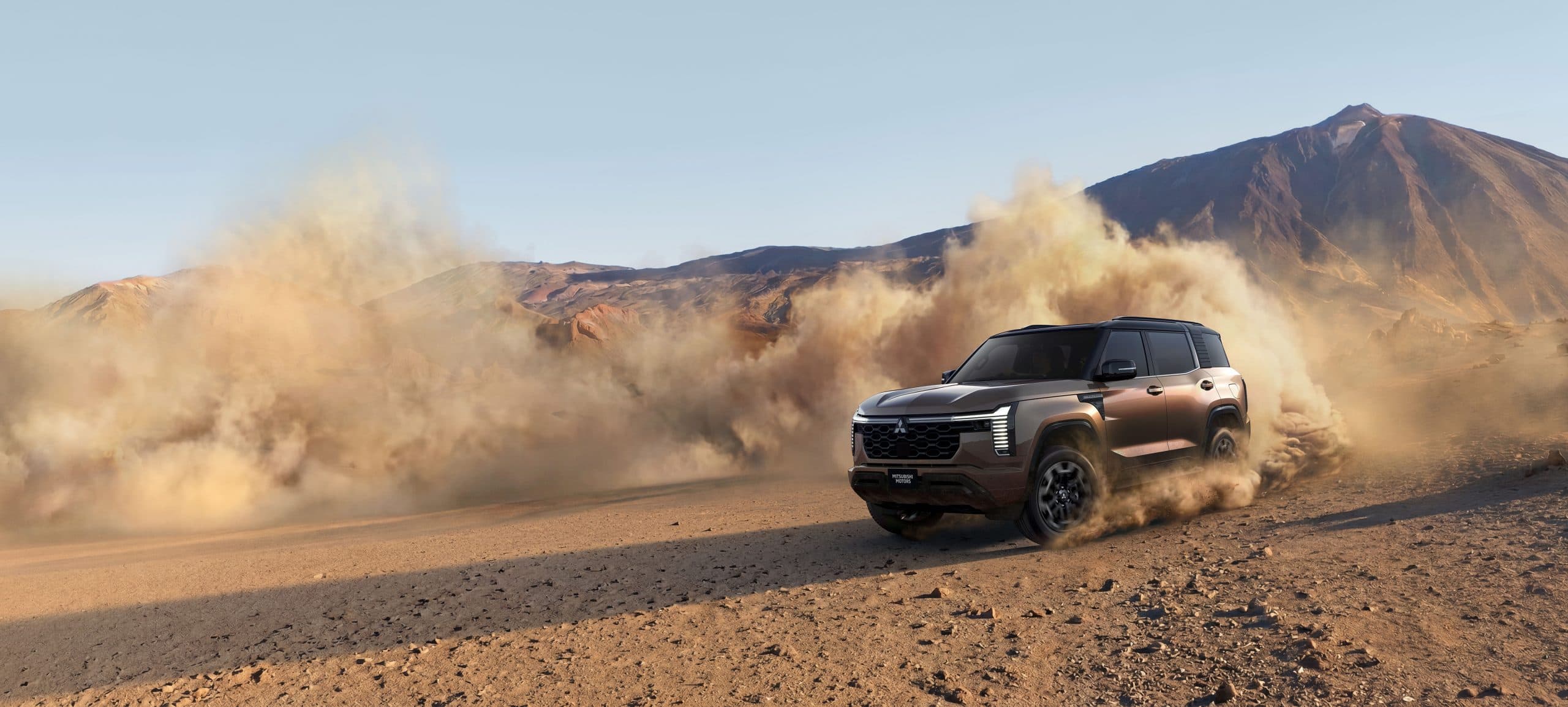
Mitsubishi Motors has lifted the covers off its fully redesigned, all-new Pajero cross-country SUV at its world premiere in Tokyo, marking the return of one of the Japanese automaker’s most iconic nameplates. Mitsubishi Namibia sales manager Andre van der Merwe confirmed to Woema that the new-generation Pajero is expected to reach the Namibian market towards the second half of next year.
A popular choice on roads worldwide, the Pajero was officially discontinued in 2021, but Mitsubishi has now revived the nameplate as a new-generation flagship model, combining its established off-road credentials with advanced technology, driver assistance, safety and greater refinement.
Mitsubishi engineers have spent five years refining the new-generation Pajero, which retains the sought-after characteristics that made its predecessors a motoring legend while introducing a more premium positioning.
Van der Merwe said Namibian motorists can look forward to the return of a vehicle with a strong reputation for durability and versatility.
“Namibian motorists have a long-standing appreciation for the Pajero’s rugged reliability and versatility, and we are excited to bring this icon back to our market,” said Van der Merwe.
Mitsubishi Motors will build the new Pajero at its production facility in Thailand, and it is destined for more than 100 countries globally, including South Africa and Namibia.
First introduced in 1982, the Pajero was developed as a cross-country four-wheel-drive vehicle combining authentic off-road performance and dependability with passenger-car-like comfort. It quickly became a favourite among outdoor enthusiasts and achieved significant success in the southern African market.
Across its previous four generations, total production exceeded 3.29 million units, cementing the Pajero’s status as one of Mitsubishi Motors’ most iconic
models.
Its reputation was further established through motorsport, particularly the Dakar Rally, where the Pajero began competing in 1983. It subsequently secured 12 Dakar victories, including seven consecutive wins.
Meanwhile, the all-new model builds on this heritage under Mitsubishi’s “Grand Charisma” design concept, with bold, upright proportions, strong horizontal lines and powerful fenders intended to give the SUV a commanding road presence. Signature design elements from previous Pajero generations also appear, including a C-pillar inspired by the roll bar of the first-generation model and a hexagonal rear motif representing the spare tyre carried by earlier generations.
Interior upgrades
Inside, the new Pajero combines functionality with a more sophisticated cabin. The horizontally oriented instrument panel takes inspiration from the first-generation Pajero, while two 14.3-inch screens form a monolithic display. A modernised Multi Meter provides information including altitude, compass heading, temperature, vehicle pitch and roll angles, and AYC control status.
The vehicle also features wireless smartphone connectivity, an advanced infotainment system and a Dynamic Sound Yamaha Ultimate audio system developed jointly with Yamaha Corporation.
The system uses 12 speakers and dual amplifiers.
Mitsubishi has also focused heavily on cabin refinement, with extensive sound insulation designed to allow occupants to converse naturally at highway speeds. Optimised seating and interior packaging are intended to provide comfort across every row.
Suspension and transmission
Underneath, the Pajero retains its rugged ladder-frame construction, while its suspension comprises an independent double-wishbone front setup and a newly developed five-link rigid rear axle.
Power comes from a specially developed 2.4-litre engine fitted with a wide-range single variable geometry turbocharger producing 480Nm. The engine is paired with a newly developed eight-speed automatic transmission with sport mode.
Off-road capability remains central to the Pajero’s identity.
Mitsubishi’s Super Select 4WD-II system provides four drive modes, namely 2H, 4H, 4HLc and 4LLc, while Super-All Wheel Control integrates systems including Active Yaw Control, Active Stability and Traction Control and ABS.
Drivers can select from seven drive modes, Normal, Eco, Gravel, Snow, Mud, Sand and Rock. The Pajero has 230mm of ground clearance, with an approach angle of 30.4 degrees, a ramp breakover angle of 22.6 degrees and a departure angle of 25.8 degrees.
Safety features
Safety technology includes Forward Collision Mitigation with pedestrian, cyclist and motorcyclist detection, Predictive Forward Collision Warning, Emergency Assist for Pedal Misapplication, Emergency Lane Assist and Front Cross Traffic Alert. The SUV also features MI-PILOT highway driving assistance, adaptive cruise control and lane-keep assist, while eight airbags include Mitsubishi’s first SRS centre airbag.
A 3D Multi Around Monitor uses four cameras to give drivers a real-time view of the vehicle’s surroundings, helping with parking, manoeuvring and off-road driving.

Comments
No comments yet. Be the first to share your thoughts.