
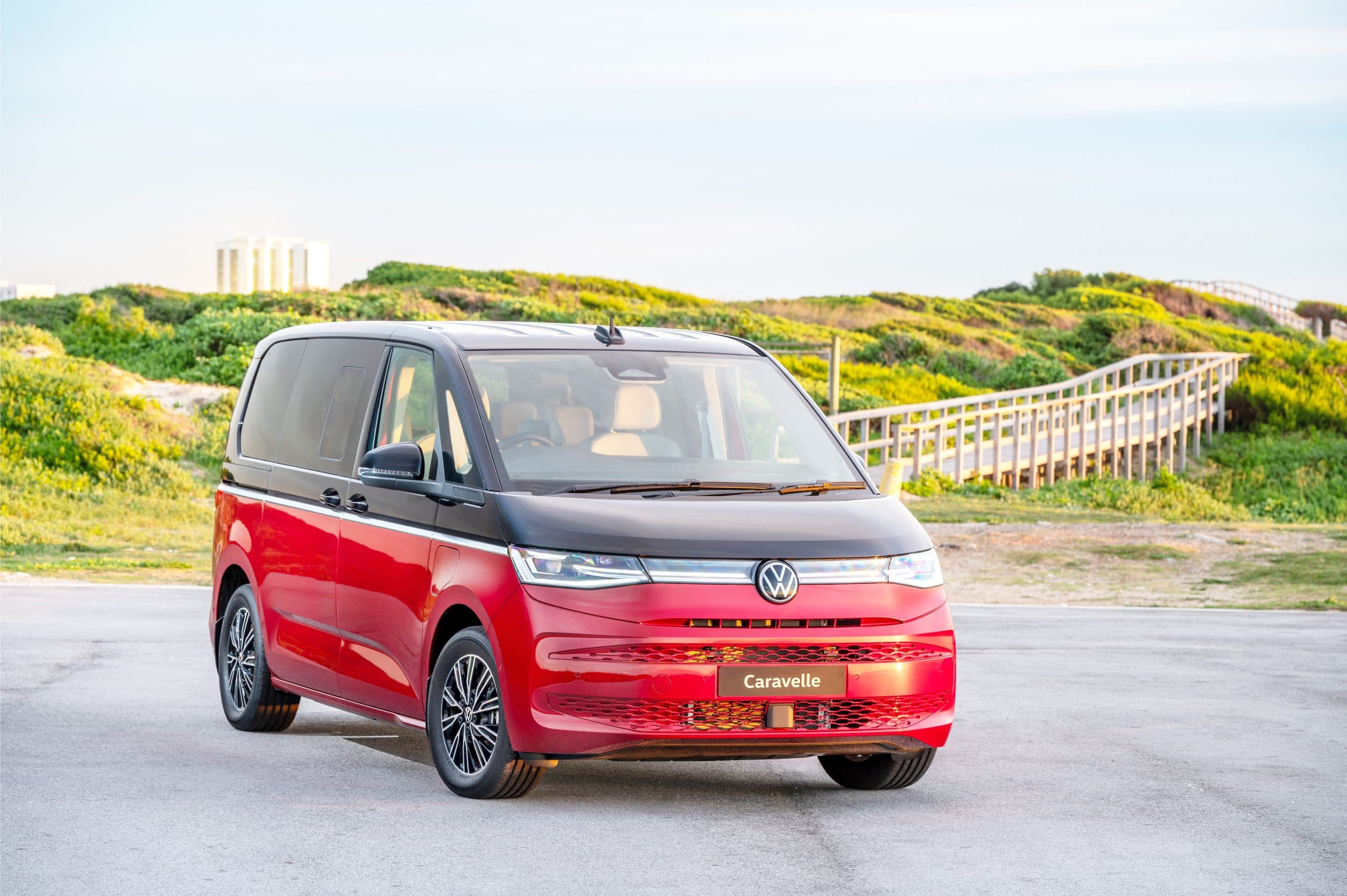
The Volkswagen Caravelle has always been more than just another people mover. Across Southern Africa, and in Namibia specifically, few vehicles have become as deeply woven into the fabric of everyday life. Whether ferrying families on long-awaited holidays to the coast, transporting tourists across Namibia’s spectacular landscapes, serving as executive transport for business leaders or carrying schoolchildren and emergency workers, the Caravelle and its Kombi predecessors have earned a reputation that few vehicles can match.
Now, more than seven decades after the original Volkswagen Bus first entered production, the latest chapter of the remarkable story has begun with the launch of the Volkswagen Caravelle eHybrid in South Africa. For Namibian enthusiasts, however, patience will still be required, with the new model only expected to reach local dealerships after at least six months.
The delayed local arrival is unlikely to diminish interest. If anything, it offers Namibian buyers time to appreciate how dramatically the Caravelle has evolved while remaining faithful to the qualities that made it an icon.
The original VW Kombi became a household name in Namibia because it was dependable, practical and remarkably versatile. It was equally at home carrying a family of seven to Swakopmund, transporting guests between safari lodges, or helping entrepreneurs establish businesses that relied on affordable and reliable transport. As subsequent generations evolved into the Transporter and eventually the premium Caravelle, Volkswagen steadily added comfort, refinement and technology without losing the vehicle’s unmistakable identity.
That continuity is what makes the VW’s new Caravelle eHybrid so significant. Rather than abandoning its heritage in pursuit of electrification, Volkswagen has chosen to evolve it.
The Caravelle eHybrid represents Volkswagen Group Africa’s belief that the transition towards electrified mobility in Southern Africa must be practical rather than revolutionary. Unlike markets with dense charging infrastructure, countries such as South Africa and Namibia require vehicles capable of delivering the environmental and efficiency benefits of electrification without introducing range anxiety or compromising the ability to travel long distances.
That philosophy explains why Volkswagen opted for plug-in hybrid technology instead of a fully electric drivetrain. At the heart of the Caravelle sits a newly developed 1.5-litre turbocharged TSI petrol engine working alongside a high-performance electric motor integrated into a six-speed DSG transmission. Together they produce an impressive 180 kW and 350 Nm of torque, making this the most powerful production Caravelle ever offered in Southern Africa.
For daily commuting, school runs or city driving, the Caravelle can operate solely on electric power for distances of up to 95 kilometres. Once the battery approaches depletion or longer journeys begin, the petrol engine seamlessly takes over or works alongside the electric motor, extending the total driving range to approximately 700 kilometres. That flexibility makes the vehicle particularly attractive for Southern African motorists, who frequently travel vast distances between towns and often venture into regions where charging infrastructure remains limited.
Owners can recharge the battery at home using the supplied 7.4 kW Wallbox charger, at public charging stations or at destination chargers installed at offices and hotels. When rapid charging is available, the battery can be replenished from 10% to 80% in roughly 26 minutes, making longer journeys considerably easier to plan.
Perhaps the most technically intriguing feature is Volkswagen’s innovative eHybrid 4MOTION system.
Unlike conventional all-wheel-drive systems that rely on mechanical driveshafts linking the front and rear axles, the Caravelle employs a dedicated electric motor on the rear axle. This allows torque distribution to be controlled electronically with remarkable precision, improving traction on gravel roads, wet surfaces and loose terrain while maintaining balanced weight distribution throughout the vehicle. For Namibian conditions—where tar roads frequently give way to gravel routes leading to lodges, farms and tourist destinations—that capability could prove especially valuable.
Inside, Volkswagen has positioned the Caravelle firmly within the premium passenger vehicle segment.
Standard equipment includes three-zone climate control, a 13-speaker Harman Kardon sound system, IQ.LIGHT Matrix LED headlamps, adaptive cruise control, Park Assist, blind-spot monitoring, electrically operated sliding doors, a powered tailgate, keyless entry and 30-colour ambient lighting. These features reinforce the Caravelle’s long-standing appeal among executive shuttle operators, luxury tourism businesses and discerning private buyers seeking comfort without sacrificing practicality.
The Caravelle eHybrid clearly occupies the premium end of the market and its arrival marks something far more important than the introduction of another luxury people mover. It signals the beginning of a new era for one of Southern Africa’s most recognisable automotive nameplates.
For generations, the Volkswagen Bus has reflected the changing needs of society, evolving from a simple utility vehicle into a sophisticated family, business and executive transport solution. The Caravelle eHybrid continues that tradition by embracing electrification without abandoning the practicality, durability and versatility that built its reputation.
When it finally reaches Namibia in early 2027, local buyers will not simply be welcoming a new model but will be witnessing the next chapter in one of Southern Africa’s most enduring automotive success stories.
– ebrandt@nepc.com.na

Comments
No comments yet. Be the first to share your thoughts.