
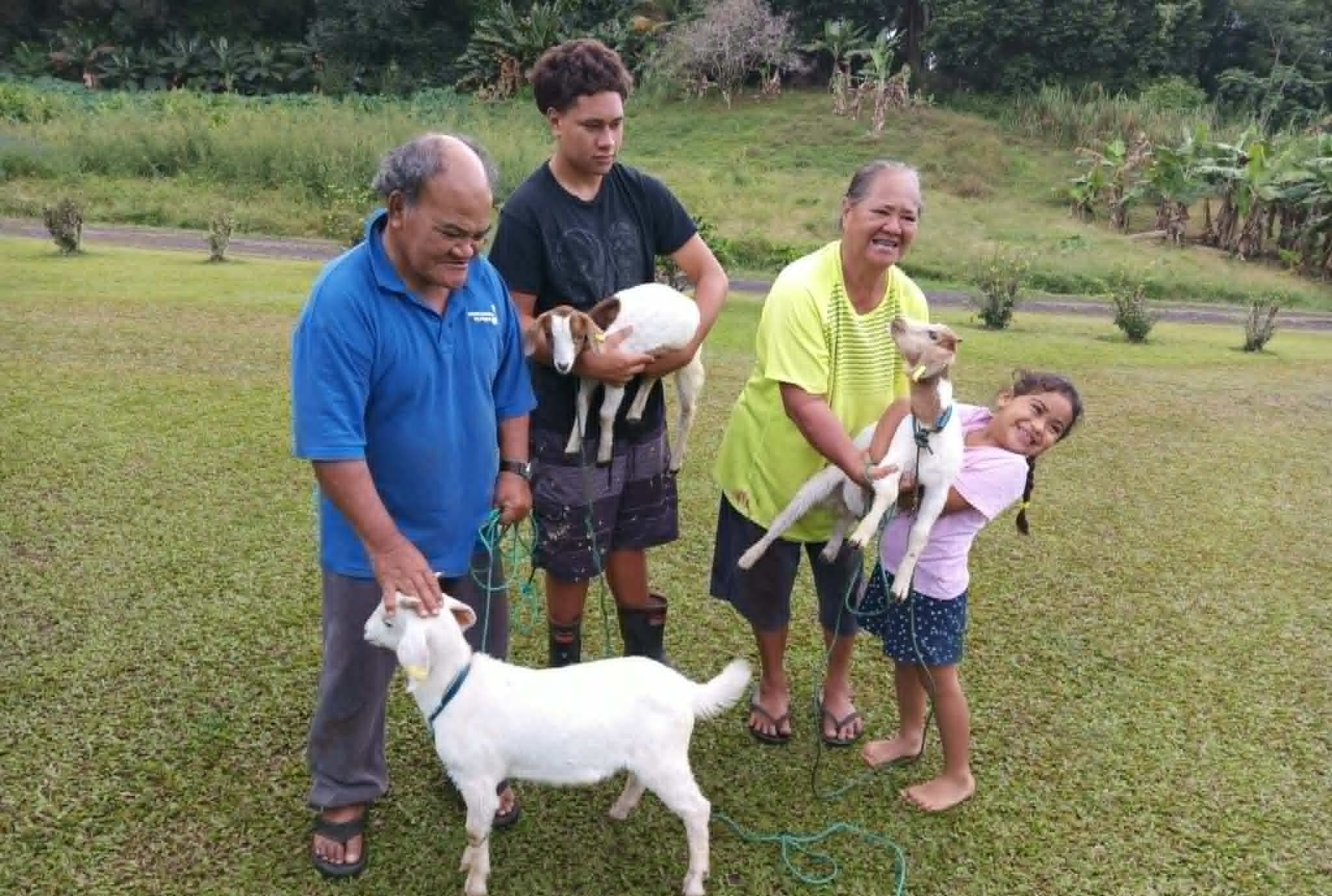
The programme, led by Te Pae Tanu Ministry of Agriculture, aims to improve livestock quality across pigs, goats and cattle, with a focus on meat production and long-term food security.
Cecilia Samuela-TouAriki, director of advisory services, said the initiative first took shape in 2023–2024 under FAO support, driven by concerns over declining livestock genetics.
“We were looking at pigs, goats and cattle – pork, goat meat and beef,” explained Samuela-TouAriki. “We know here in the Cook Islands, we don’t actually have any pure breeds anymore. So the thought was to improve that.”
At the planning stage, the Ministry reached out to former livestock officer Tinirau Tamarua, who had previously worked on a pig breeding programme and provided key technical guidance.
In September 2024, a technical expert from New Zealand, working under Animal Breeding Specialist (ABS), conducted scoping visits on Rarotonga.
Pigs, goats and cattle are kept on scattered private farms across the island.
“One of the challenges is that agriculture here doesn’t have a central farm. Everyone is spread out, so it was quite a challenge logistically,” said Samuela-TouAriki.
However, the programme was assessed as feasible under local farming conditions.
The first insemination trials for pigs and goats were carried out in August 2025 under a reproductive specialist programme.
According to Samuela-TouAriki, pigs have a gestation period of around three months, three weeks and three days, while goats carry for about five months.
As a result, both species were prioritised due to their manageable breeding cycles.
Initial targets included around 20 pig farmers and 10 goat farmers.
But, early trials highlighted challenges, particularly with gilts (young female pigs), whose cycles proved difficult to synchronise.
Samuela-TouAriki said they learned that gilts are generally not used in artificial insemination programmes due to reproductive challenges, reinforcing the decision to focus on sows.
Focus was shifted to sows, which already have established reproductive cycles.
The first round produced one sow and one gilt giving birth, along with one doe (adult female goat).
The first piglets were born in December, followed by goat kids in late January.
A second insemination round carried out in October delivered stronger results, with five sows successfully giving birth in Takuvaine, Titikaveka and Matavera.
Three goats produced kids in Titikaveka at the farms of Raui Masters and Mama Tuteru.
“We were happy with the outcome, and we learned a lot from the first round in terms of what type to use,” Samuela-TouAriki said.
Continued breeding cycles will be needed for restoring improved livestock lines, as most animals in the Cook Islands are already crossbred.
At present, the country also lacks quarantine facilities for importing live animals, making artificial insemination a key alternative for stock improvement.
“We want to continue the process and we need to carry out more cycles to get closer to a pure breed again,” Samuela-TouAriki said.
Challenges remain, particularly around feed management and coordination among farmers spread on the island.
The Ministry is urging farmers not to rush breeding and to ensure animals reach the correct size and weight before mating.
“Farmers should not mix boars and sows randomly. We need proper tracking so we maintain improvement, not repetition,” she said.
Despite the limitations, Samuela-TouAriki said progress has been encouraging, even if numbers remain small.
“It’s still progress compared to previous figures.”
Looking ahead, there is growing interest in improved livestock breeding in the Pa Enua.
For pigs, the focus is on the Duroc breed, which was previously introduced but has since become crossbred. Duroc is valued for its adaptability to local heat, feed conditions and meat production.
Farmers have also expressed interest in Large White (Puaka Papa’a), known for its strong productivity.
For goats, the Boer breed is being developed as a meat-focused line rather than for milk production.
Farmers such as Mama Tuteru and Raui have already reported positive early outcomes.
Technical aspects of the programme include strict timing and handling protocols.
Local insemination work is being carried out by Raita Vakapora for goats, and both Vakapora and Samuela-TouAriki for pigs.
“Pigs are more difficult because of size and timing, but the process is manageable,” she said.
Samuela-TouAriki also noted that synchronising breeding cycles and coordinating across dispersed farms remains one of the programme’s biggest operational challenges.
“In New Zealand everything is centralised on a farm. Here, we have to travel from farm to farm, so timing becomes critical.”
The Ministry says the programme is now better structured and is confident in its approach to improving livestock numbers in the country.

Comments
No comments yet. Be the first to share your thoughts.