
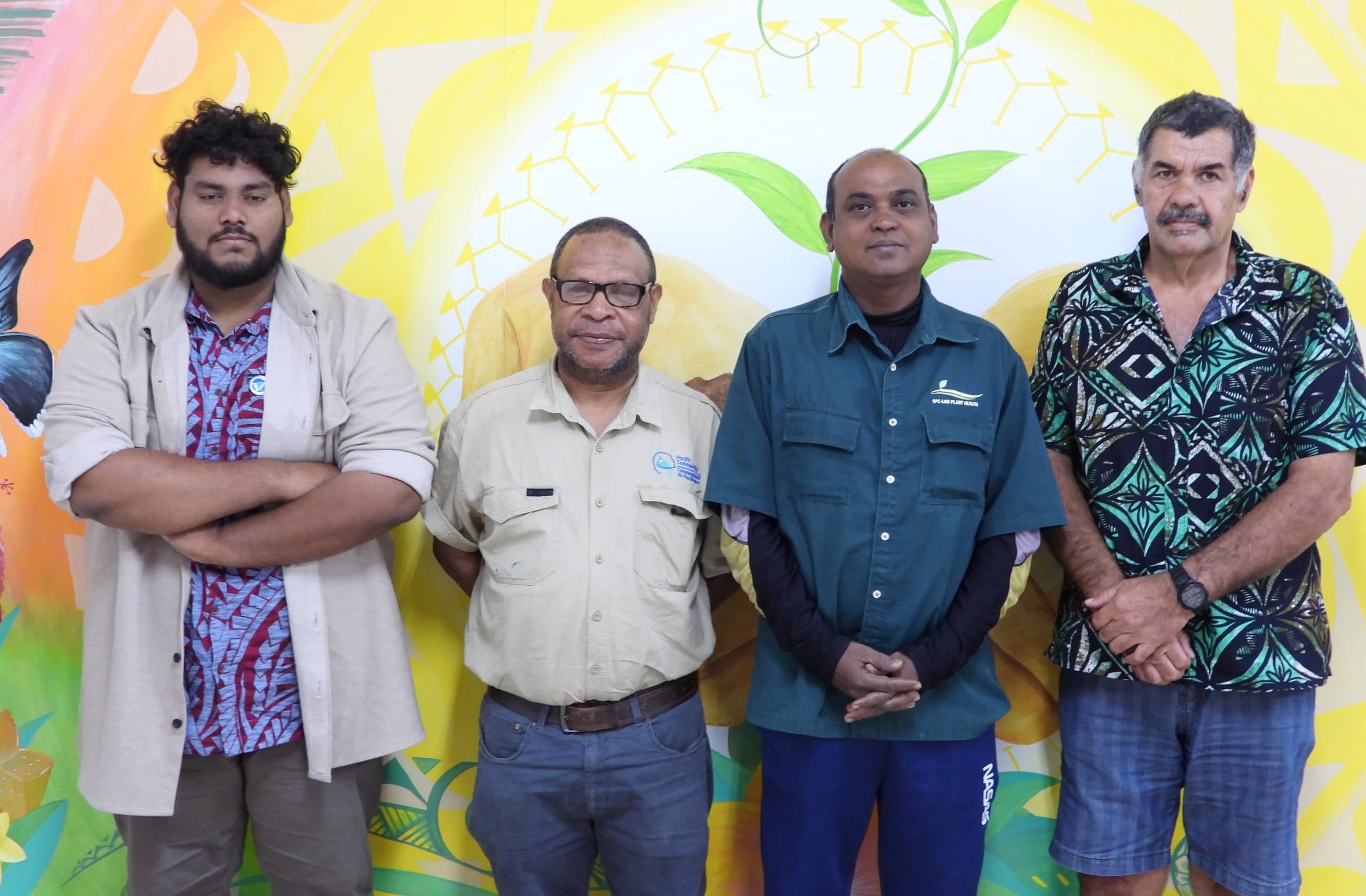
SPC pest and disease adviser for the Land Resources Division, Dr Mark Eru, research intern Niyaz Ali and entomology technician Nitesh Nand are on Rarotonga conducting laboratory and field trials to identify effective ways of managing the infestation while protecting the island’s natural ecosystem.
The work follows a request from the Ministry of Agriculture to SPC last year after concerns grew about the spread of the white-footed ant and associated pests.
Dr Eru first visited Rarotonga in May to assess the situation and found the infestation widespread across the island, including significant infestations affecting coconut trees.
“There was a widespread infestation right around the island, with some obvious infestations, especially on coconuts,” he said.
One of the major problems identified was coconut scale, a sap-sucking insect that can severely affect plant health.
Dr Eru said the white-footed ants themselves were not directly damaging plants.
“The ants don’t sting, and they don’t bite. But once they’re in a large population, they cause nuisance.”
Instead, the ants have formed a symbiotic relationship with sap-sucking insects, protecting them from their natural enemies in exchange for honeydew, a sugary substance produced by the insects as they feed on plants.
The ants aggressively defend the sap-sucking insects from predators and other biological control agents.
“Usually in the normal situation, the natural enemies, biological control agents of the sap-sucking insects, keep them under control,” Dr Eru said. “But with the ants, what they’re doing is chasing away the natural enemies.”
With fewer predators, sap-sucking insect populations can increase rapidly, putting greater pressure on plants.
Their honeydew also contributes to the growth of sooty mould, which appears as a black coating on leaves and can interfere with photosynthesis and plant growth.
“Once that’s covered, it also affects that process,” Dr Eru said. “It affects the plant growth.”
While sap-sucking insects have been present in the Cook Islands for years, Dr Eru said the scale of the current infestation was unusual.
Researchers investigated whether unusual weather conditions could have contributed to the population explosion.
Historical weather data covering the past 30 to 40 years was obtained from the national weather service, but there was no clear evidence of an unusual weather event causing the increase.
Instead, the evidence points towards the introduction of the white-footed ant, which is not native to the Cook Islands.
“The sap-sucking insects, they’ve been here, and there are a lot of natural enemies that we’ve picked up in large numbers,” he said.
“They have been keeping them under control. But I think the situation we are having now is the incursion of the white-footed ants.”
Dr Eru said the ants’ protection of the sap-sucking insects could eventually reduce natural enemy populations, as predators are driven away from their food sources.
A similar pattern has been observed in Fiji, where white-footed ant populations increased before eventually declining.
Rather than relying on broad-spectrum pesticides, researchers are looking at an integrated pest management approach that combines ant control with biological control of the sap-sucking insects.
Among the biological control agents already found on Rarotonga is Cryptolaemus, commonly known as the mealybug destroyer.
Researchers found about 100 of the beetles on a single tree during their investigation, suggesting the natural predator is already well established in parts of the island.
“If that can be promoted and released back into the field, then it will help with the process,” Dr Eru said.
Other natural enemies, including parasitic insects, are also being investigated.
The team has collected sap-sucking insects and will monitor them to identify which parasites emerge. Once identified, those biological control agents could potentially be mass-produced and released in areas where natural enemy populations are low.
Dr Eru said strengthening natural enemy populations was important because continued disruption from the ants could eventually leave predators without enough food to survive.
“That’s why we need to have a system where we build up the population as a backup.”
The current field trials are examining three spray options – neem oil, white oil and a soap solution – with researchers monitoring their effectiveness against the pests, their cost and any potential damage to plants.
The trials will run for about three months, with treatments applied fortnightly and results monitored over time.
Researchers are also testing baiting systems to target the white-footed ants directly.
Fipronil has emerged from laboratory testing as a suitable candidate for ant bait, but Dr Eru stressed that it must be used carefully.
While fipronil can be effective against ants, broad application can also harm beneficial insects.
The team has therefore developed a contained baiting system using a small bottle containing a mixture of honey, sugar and a small amount of bait.
The design is intended to limit exposure to domestic animals and prevent unnecessary chemicals from entering the environment.
The approach is particularly important in the Cook Islands, where the water table is low and the ocean is close to communities and agricultural areas.
“We don’t want to use a lot of chemical sprays,” Dr Eru said. “We try, as much as possible, to use options that are softer, that do not have any impact on the biological control agents.”
He said stronger pesticides should only be considered where they could be applied in a controlled way without harming the environment, beneficial insects or people applying them.
Dr Eru emphasised the research was not about finding a quick fix.
“It’s not a silver bullet,” he said. “It takes time.”
The aim is to develop a management package suited specifically to the Cook Islands environment, balancing effectiveness with environmental and economic considerations.
Laboratory trials have already produced data on the effectiveness of potential treatments and their impact on natural enemies.
The field trials will provide further information over the next three months before researchers make a final recommendation.
Dr Eru and his team are also expected to return during the project to assist with monitoring and assess the results before a longer-term management strategy is developed.
Ministry of Agriculture director for crop research William Wigmore said the findings could also help prevent the pest from spreading to other islands.
Wigmore said Aitutaki, which he has visited several times, currently has relatively healthy coconut trees compared with some areas of Rarotonga.
He urged people to be careful about transporting plants, insects or other potentially contaminated material between islands.
“If they would like to take anything to the Pa Enua, come and see us.”
The Ministry of Agriculture is already working on pest management, Wigmore said, and the SPC investigation is intended to better understand the current situation and improve existing measures.
For Dr Eru, the key is restoring the natural balance rather than eliminating every insect.
“It’s the incursion of the ant that has affected the natural enemy,” he said. “If we build up the natural enemies, then we can release more of them into the affected areas.”


Comments
No comments yet. Be the first to share your thoughts.