
Zebaldt Ngaruka
Livestock exhibitors at the just-ended Epukiro Business and Agricultural Expo raised concerns over a lack of farming land in their respective communal areas.
The showcasing event that attracted massive participation from both farmers and spectators is the talk of the nation due to the quality of the livestock displayed.
Among the issues raised was the harsh conditions affecting the cattle brought to the event, including insufficient land, persistent droughts, stock theft, water scarcity, poisonous plants and lack of diversified market access.
Speaking on behalf of the exhibitors, renowned Brahman Stud farmer Edison Katjipuka said the challenges farmers face remain persistent and stick around, as without farmers, the nation will starve and fall into a deep poverty trap.
Katjipuka said it is not everyday that the rural communities are in the presence of senior government and regional leaders, who are the right channels for farmers to air their concerns.
Among the government top leaders who were present at the Epukiro Business and Agricultural Expo were Dr Kaire Mbuende, Director of the National Planning Commission; Finance Minister Erica Shafudah, agriculture Deputy Minister Ruthy Masake, Omaheke Governor Pijoo Marikutuka Nganate, Chairperson of the Omaheke Regional Council Rocco Nguvauva, the Chief Regional Officer Peka Semba, Epukiro constituency councillor Pineal Packey Pakarae and other government officials.
“We have lived by the true word of ‘don’t ask what your government can do for you but ask what you can do for your nation.’ Food security and farming sustainability remain our key focus,” he stated.
Despite being grateful about government support extended so far, Katjipuka said a lot needs to be done.
“We, the farmers, are strategic stakeholders in the food value chain and urged to be involved, or our inputs considered in projects and national policies that affect initiatives such as the resettlement programme.
Even through Agribank funding and other funding vehicles,” he said.
Katjipuka emphasised that farmers’ views are that the resettlement programme did not produce the expected results in the existing vast arid land available in the rural areas.
“Government should instead develop this land by drilling boreholes and fencing and provide them with added services such as electricity and mobile network,” proposed the stud breeder.
Furthermore, Katjipuka said the historical measurement of estimated open space between Otjombinde’s Eiseb Block and Epukiro, where most of the farmers are residing, is around 1.4 million hectares (ha).
He added that the conversion rate of the average commercial economic size unit of 5 000 ha is around 280 farms.
According to Katjipuka, the government is currently paying an average current price of N$4 000 per ha, which equals 5000 ha multiplied by 4000, and thus equals N$20 million spent.
“Our government can develop a similar size of land for a fraction of the amount, plus the ownership still remains with the state. The land once developed can be allocated to the farmers on a leasehold basis of 99 years with a title deed,” stressed Katjipuka.
He reiterated that the allocation of the title deed is a key enabler of wealth creation with the goal of building a self-sustainable nation.
“Wealthy nations have built their economic wealth through the use of their own natural resources,” he said.
Moreover, Katjipuka said the Agribank funding model for previously disadvantaged farmers, irrespective of whether they are rural or commercial farmers, remains a challenge.
“Mentorship, coaching and after-sales support remain evasive with no hand held during times of distress,” he added.
Exhibition
The show impressed visitors with high-quality small stock, dogs and cattle competitions, which produced winners across various breeds.
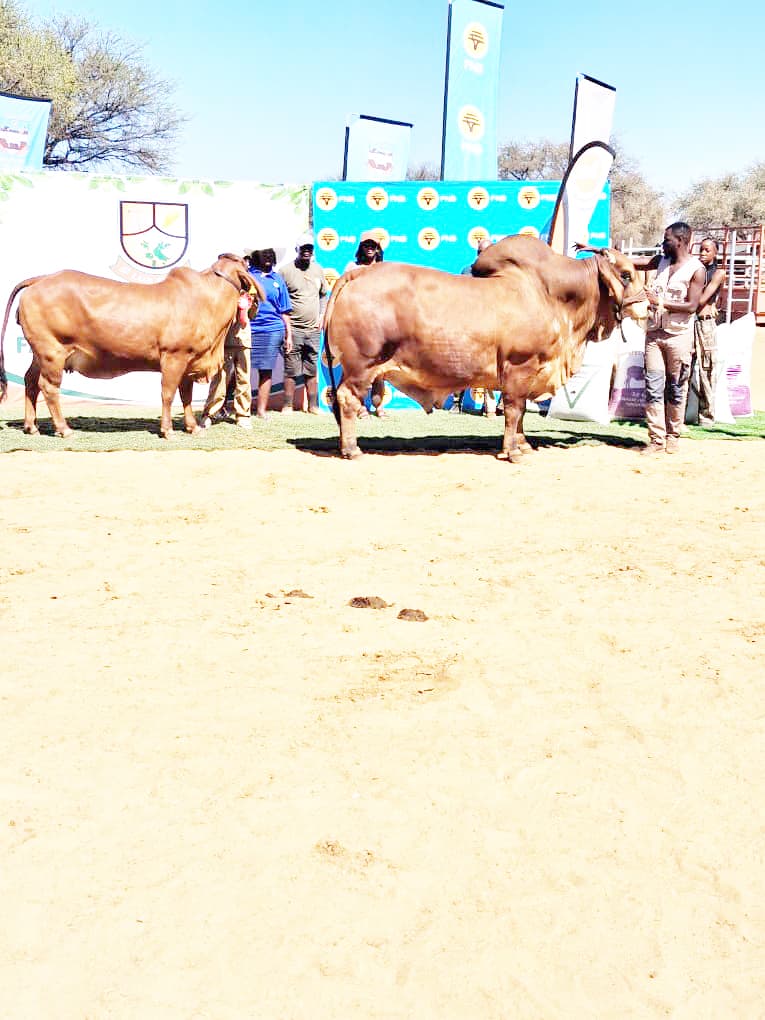
Brahman cattle were the main attraction, as most livestock entered at the event were Brahmans and were allocated a special competition day. Benii Murangi of Muna Farming took top honours after his bull, Boetman, was crowned Champion of Champions, while an Okanene Brahman stud cow, Aurora, won the same accolade in the female category.
Murangi’s bull was reserved by Vasana and Sons, a Simmentaler bull called Yellow Man, whereas Aurora was reserved by another Okanene Brahman stud heifer named Kelisha.
Okanene Brahman Stud is the house of the popular communal area bull known as Pule from Komboro genetics, the current champion bull at the Gobabis and Windhoek Agricultural Shows, despite its retirement from showcasing events.
Other top earners were Katjirua’s Omukutua Farming bull, which showed a masterclass in its category, while Shamrock Brahman, Wolle Brahman, Karima, Ambromanso, Ruano Mieze’s RM2 Brahman, Samora Hoveka, Ruho Farming, Katz Tjozongoro and Ndjarua Kahuure, among others, also did well in their respective breed classes.
The small-stock category awards went to Adam Murangi when his Kalahari Red ram won the Champ of Champs, whereas in sheep competition Isando Kaverukua Kavari emerged with his Van Rooi sheep ram.
Other small-stock farmers like Vaongasana Mujoro, Kapuvii Pura, Otjombiņde’s Tjozohongo Nguvauva, Okaundua’s Tjiuu Kaunatjike, Otjinene’s Ukaurua Kandee, Kausehue Marenga, Klein Okeparu, Rivereka Farming, Kaurihongua Murangi, Foreman Ndjavera, Okondjatu and Okotjituuo farmers, among others, also did well at the event.
Renowned dog breeder Muveri Kavari won top honours in the dogs’ competition, while Kamakotje Marenga did well in the dogs’ division as well.

Comments
No comments yet. Be the first to share your thoughts.