
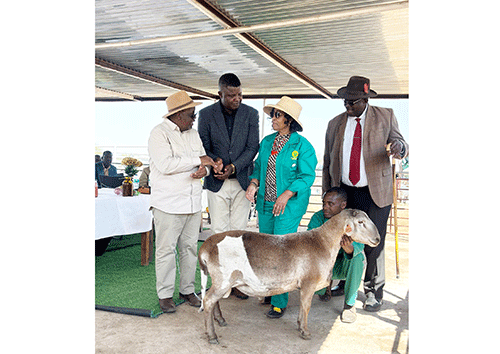
The 22nd Aminuis Annual Agricultural and Industrial Show, held under the theme ‘Cultivating a Legacy of Excellence’, brought together dedicated farmers, agribusinesses, exhibitors, innovators, development partners and stakeholders from across Namibia.
United by a shared commitment to advancing the agricultural sector, Namibia’s economic growth, food security and rural development, this year’s edition again demonstrated that it is one of the country’s biggest agricultural and industrial shows.
All participants showed resilience, commitment, and a shared vision to promote agriculture as a driver of economic development and food security, to present quality livestock competitively on bigger stages, and to foster a culture of continuous improvement.
Launching the show, agriculture minister Inge Zaamwani commended the Show Society, stating that despite the severe drought of 2024, it has left a legacy of excellence in practice, hard work, and responsible stewardship, even when conditions were at times unfavourable.
Zaamwani remarked that the pursuit of excellence is central to Namibia’s Sixth National Development Plan (NDP6), which identifies agriculture as a strategic priority to drive inclusive economic growth, create employment, strengthen food and nutrition security, and enhance rural livelihoods.
She added that achieving these national aspirations requires excellence in planning, production, value addition, service delivery and partnership at every point along the value chain, from the communal kraal to the export market beyond our borders.
“When our ministry previously advised Aminuis farmers to diversify into crop farming to strengthen household food security, that advice was not offered lightly, and I am told it was received in the same spirit and continues to resonate throughout this settlement. That is precisely how policy is meant to work; guidance given, taken seriously, and acted upon at household level,” said the minister.
“I am aware that the communal areas of Omaheke region, and Aminuis constituency in particular, carry a significant share of Namibia’s small livestock and contribute heavily to the national livestock sector. Provisional data for the first half of 2026 point to broad-based growth in cattle and sheep marketing, supported by competitive pricing and expanded live exports.”
Growth
Furthermore, she reported an increase in the cattle sector, where 126 672 head were marketed in the first half of the year, compared with 122 865 head in the corresponding period of 2025.
Similarly, there has been an increase in live exports, which rose by 47.4% to 39,083 head, up from 26 523 last year, a clear signal of the confidence the market places in local producers and pricing.
She took time and urged the youth to take advantage of the region’s comparative advantage of extensive sandveld grazing, well suited to small and large stock, a strong tradition of livestock husbandry, growing crop diversification, and proximity to the Trans-Kalahari Corridor and the Botswana border, which opens regional trade routes beyond South Africa.
“The opportunity before you is not only to keep producing at the primary level, but to move higher up the value chain, into feedlots, hide and leather processing, wool handling, packaging and logistics, areas where value is added and retained closer to home rather than exported as a raw commodity,” she urged.
She also called on farmers to always prepare themselves in terms of consistent animal health record keeping, traceability, and compliance with sanitary standards in order to expand beyond the traditional trading partners, as interest from markets such as China is growing for Namibian beef and livestock products.
Omaheke regional governor Pijoo Nganate emphasised that the future of the region depends on diversifying agriculture and expanding economic opportunities across the entire agricultural value chain and pointed out to the government interventions of investing in strengthening rural livelihoods through drought relief programmes, improved water infrastructure, land reform and farmer support initiatives.
He said such assistance has helped thousands across the region to build resilience against the recurring effects of drought and climate change.


Comments
No comments yet. Be the first to share your thoughts.