
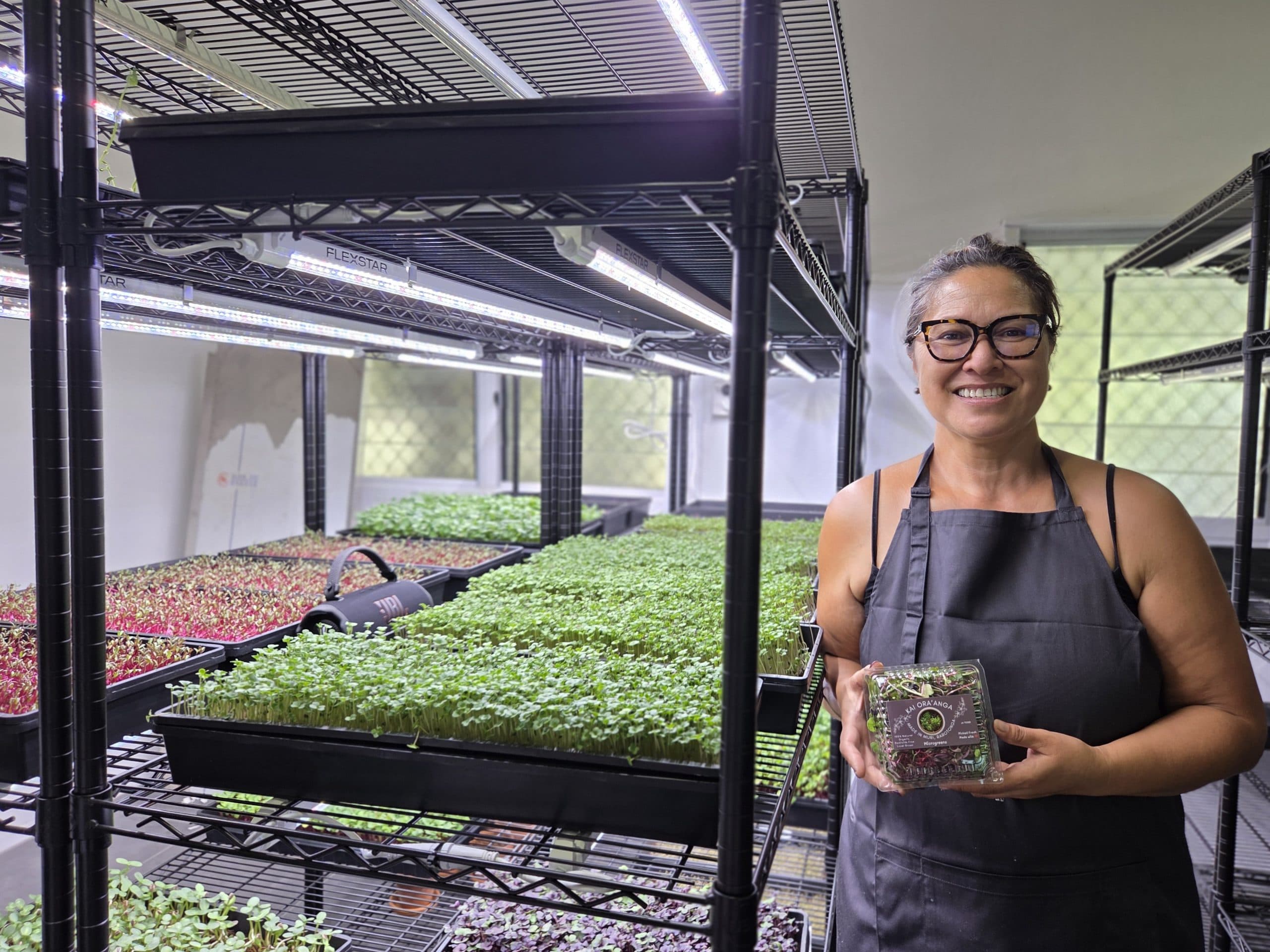
Barbara Marsters, of Aitutaki and Palmerston descent, has opened Kai Ora’anga Microgreens in Muri, producing a range of nutrient-dense vegetables harvested at their earliest stage of growth.
While the business is still in its early stages, Marsters has bigger ambitions than simply selling produce.
Her long-term vision is to educate people about healthier food choices and eventually introduce microgreen growing systems to the Pā Enua.
“I just want to bring this to the islands and educate and give some knowledge back to the local community,” Marsters tells Cook Islands News.
Growing food has been part of her life since childhood.
Raised in a family that grew its own vegetables and flowers, Marsters developed a love for gardening at a young age.
However, her professional career took her in a different direction.
For more than 20 years, she worked as a public servant across New Zealand and Australia, holding positions in government ministries and departments, including a stint at the Cook Islands Ministry of Justice.
Alongside her government work, she also operated several businesses in Sydney, including accounting, disability support and trucking companies.
Following the Covid-19 pandemic, Marsters and her husband relocated from Australia to New Zealand to care for their son, who has a disability. During that period, she stepped away from business and dedicated herself to family responsibilities.
It was while caring for her son that she rediscovered her passion for growing food and first came across microgreens.
Living back in New Zealand reminded her of the lifestyle she enjoyed growing up, and she soon became fascinated by the concept of producing vegetables in miniature form with high nutritional value and rapid growth cycles.
Now, with her son settled into his own home and her husband taking over as his primary caregiver, Marsters felt it was the right time to pursue a new venture.
“I’ve always wanted to move back home,” she shares. The move is part of a broader family plan that includes building on family land in Aitutaki while establishing a permanent base in Rarotonga.
For Marsters, Kai Ora’anga represents more than a business opportunity.
“It’s been challenging but it’s also been rewarding, though, coming back home.”
She says the venture has also helped bring her family together after the disruption many families experienced during the pandemic.
“I think after Covid, we were sort of fragmented, as most families were,” shares Marsters. “Then it took us a while to find those pieces and come back together again. This is like the pinnacle pole for us as a family.”
The business currently grows about 10 varieties of microgreens, including broccoli, beetroot, sunflower, peas, coriander and several radish varieties.
Unlike traditional vegetables, microgreens are harvested shortly after germination and can be ready in as little as seven days.
Marsters says the quick turnaround allows for a continuous supply of fresh produce regardless of weather conditions.
“This is broccoli. This is a mini version of a broccoli,” she explains, pointing at it. “It only takes seven days to grow.”
The operation uses coco coir, a growing medium made from processed coconut husks, rather than soil.
According to Marsters, the system is chemical-free and does not require pesticides, making it suitable for indoor growing environments.
“It’s clean. It’s pest-free.”
The microgreens are grown under lights and can be harvested directly from the trays, with some customers purchasing live trays to keep in their kitchens.
Marsters believes the product could play an important role in improving dietary habits in the Cook Islands, where non-communicable diseases remain a major concern.
She points to issues such as diabetes, heart disease, high blood pressure and obesity as reasons why healthier food choices should be encouraged.
“I just feel like I want to bring this standard to the island and why not?”
However, Marsters admits changing habits will take time. Despite strong interest from visitors, local uptake has so far been limited.
“At the market last week, it just went mad with the papa’as,” she says. “I was sold out to them. Not one local bought a punnet.”
She believes many people still misunderstand what microgreens are.
“People think microgreens are greens. It’s not. It’s veggies, but in a micro form.”
Marsters hopes education and greater awareness will eventually encourage more local families to include them in their diets.
She currently sells small punnets for $8 and says the produce can be eaten with almost any meal, including fish, corned beef, taro and maniota.
“I eat it with my corned beef and my kai and my maniota,” shares Marsters.
“Instead of having the lettuce and tomato cucumber, I have microgreens.”
Looking to the future, Marsters hopes to expand the operation into a larger warehouse and eventually share the growing technique with communities in the outer islands.
“I’d love to take this to another level where I can share the knowledge for the outer islands.”
She believes a relatively small setup could help improve access to fresh vegetables in remote communities.
“Just having one rack will feed one of the Pa Enua.”
Marsters says there has already been strong interest from family members in Aitutaki, while she also hopes to eventually take the concept to the Northern Group islands, including Tongareva.
“I’d love to do a trip over to Tongareva and all those outer islands and try and just do a setup.”
She hopes future support from government agencies or community organisations could help make that vision a reality.
Beyond business growth, Marsters also wants to support community initiatives, particularly programmes involving youth and people living with disabilities.
“I love to give too,” she says. “I’ve always loved supporting the youth. I love supporting the kids as well.”
Meanwhile, the next phase of Kai Ora’anga is already taking shape.
Marsters and her family are preparing to open a microgreens salad bar from the Muri premises, offering salad bowls, rice paper rolls, nori rolls and baguettes featuring their home-grown produce.
The venture is run entirely by family members, with her husband and sons helping to build and operate the business.
While she hopes the business succeeds commercially, Marsters says profit is not her main motivation.
“It’s not about the money, really.”
Instead, her focus is on encouraging healthier lifestyles and helping people discover the benefits of fresh, locally-grown food.
“Hopefully people will see that and go, ‘Oh, that is actually really good for you’.”

Comments
No comments yet. Be the first to share your thoughts.