
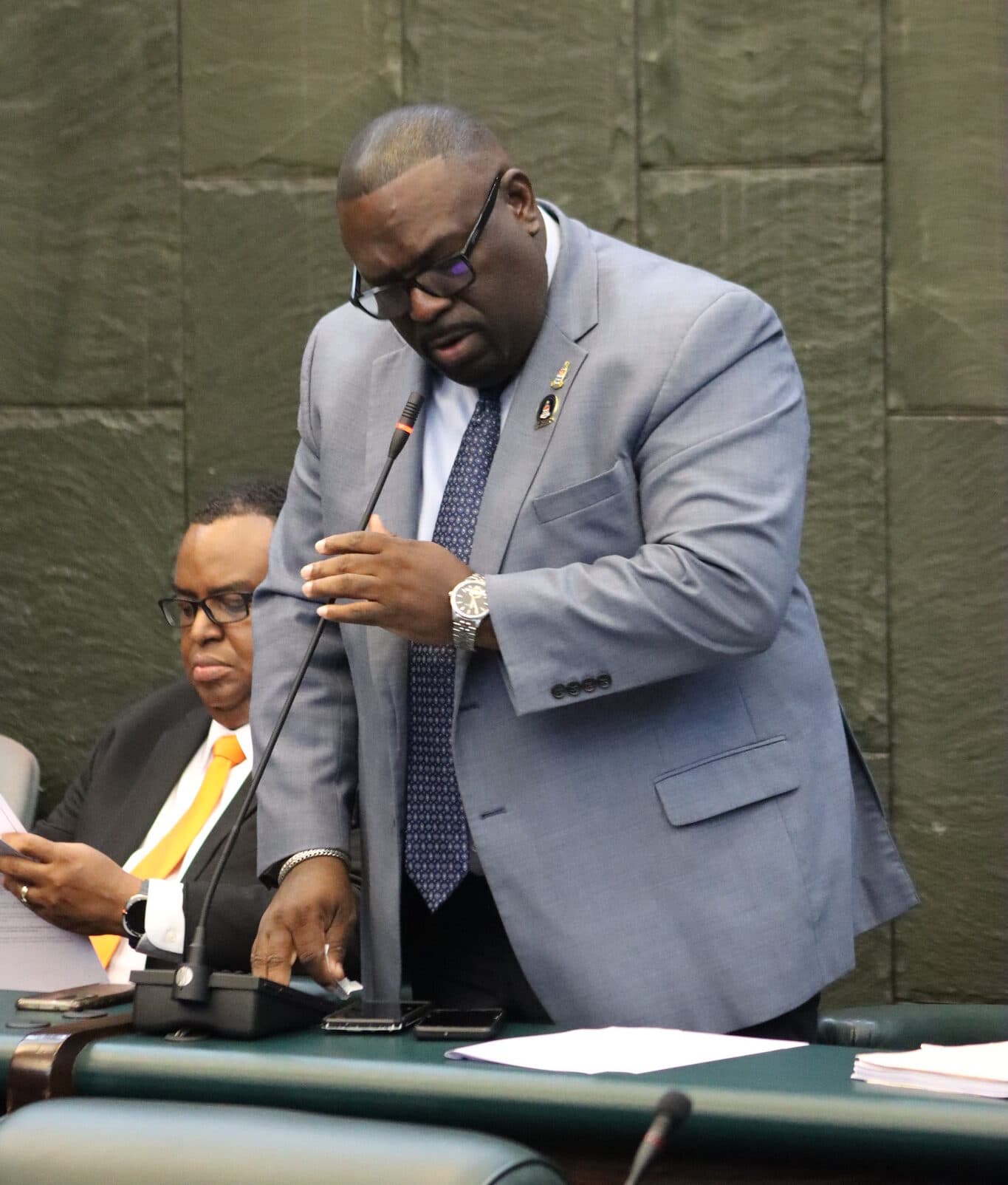
Bodden Town East MP Dwayne Seymour has called for tougher penalties for sexual offences against children, telling Parliament he sees “far too many five-year sentences or less” as police figures show children accounted for most reported sexual-offence victims in Cayman last year.
Introducing a private member’s motion on 1 Oct., Seymour asked government to consider higher maximum penalties, mandatory minimum prison terms for the most serious child sexual offences and a comprehensive review of legislation intended to protect children.
During the parliamentary discussions, Savannah MP Heather Bodden highlighted RCIPS statistics showing that children at the time of the offence accounted for 58% of victims in sexual offences recorded by police in 2025, nearly all of them female.
Police recorded 125 sexual offences that year, a 20% increase. The rise was mainly associated with offences involving girls under 16 and crimes involving the possession, taking or making of indecent images of children.
Bodden warned that the reported figures might not capture the full extent of abuse.
“No one can definitely say how widespread sexual abuse is or say with any certainty that the cases reported are the only instances of abuse that are taking place,” she said.
“I see far too many five-year sentences or less,” Seymour said. “There must be a reason why, because I know our court system in Cayman is tough on crime.”
He said Parliament has a responsibility to review penalties to reflect the seriousness of offences, acknowledge victims’ suffering and make clear that offenders face consequences.
“If the penalties available for offenses against children no longer reflect the gravity of the harm caused, then Parliament has the authority and the responsibility to review them,” he said.
Seymour added that the Children (Amendment) Act, 2024, had not yet taken effect, despite Parliament passing it on 16 Dec. 2024. The Act requires Cabinet to set its commencement date by order and allows different provisions to take effect at different times.
Both Seymour and Bodden warned that abuse can begin through apparently harmless interactions, with offenders gradually exploiting a child’s trust.
“A child cannot meaningfully consent to exploitation. A child cannot fully appreciate manipulation by an adult. A child places trust in adults because children are taught to trust,” Seymour said.
He described how grooming can develop from attention and apparent friendship into emotional dependence, secrecy and abuse.
“It often begins with kindness, with compliments, with gifts, with friendship, with someone pretending to understand a lonely child,” he said.
“Gradually, the relationship changes. The child becomes emotionally dependent. Boundaries are crossed. Images may be requested. Secrets are encouraged. Manipulation replaces friendship. Eventually, exploitation follows.”
By the time parents become aware, he warned, “enormous damage may already have been done”.
Bodden said technology had widened the opportunities for offenders to reach children without being physically near them.
“Today, someone seeking to exploit a child does not even have to approach them face to face,” she said. “They can reach the child through a phone, a game, an app, or a seemingly innocent message.”
She warned that grooming could be “hiding behind a screen, slowly building trust” and hence could be difficult for both parents and children to recognise.
She also cautioned that the danger was not confined to strangers.
“The reality is sexual abuse is also perpetrated within the family environment. Our system of protections must be capable of recognising and managing that reality,” she said.
Seymour similarly warned that offenders may be relatives, trusted professionals or people in positions of authority.
Recent court cases illustrate the concerns raised in Parliament. In February, George Martin Slijper was sentenced to 14 years for offences involving three girls he contacted through Snapchat or Instagram, including raping two 13-year-olds.
Seymour’s call for stronger punishment also comes against a record of delays within the justice system.
In February 2025, a man convicted of abusing a girl from the age of seven until she was 12 received a sentence which ultimately amounted to one year and three months after deductions because delays in his trial and sentencing left him under curfew and electronic monitoring for more than four years.
Child safeguarding agencies also face scrutiny. In August, the Ombudsman launched an investigation after reviewing police case files and identifying possible missed opportunities to protect child victims.
The investigation will examine the RCIPS, the Multi-Agency Safeguarding Hub and the Department of Children and Family Services, alongside action on recommendations from a 2024 internal MASH review.
In January, Director of Public Prosecutions Simon Davis also warned that rising child sexual-exploitation cases required greater capacity and appropriately trained prosecutors to protect children and vulnerable witnesses.
“There has been a notable rise in cases involving child sexual exploitation,” he said. “This increase will require greater capacity to ensure appropriately trained crown counsel are in place to protect the interests of children and vulnerable witnesses.”
Seymour said protecting children required safeguards against repeat offending as well as support for those already harmed.
“Where an individual has demonstrated a willingness to prey upon children, government has a legitimate responsibility to consider whether additional safeguards are necessary to reduce the risk of reoffending and to protect future victims,” he said.
He also urged Parliament to recognise that its responsibility to survivors extends beyond prosecuting and imprisoning perpetrators to supporting and protecting victims and their families.
“If we are truly committed to protecting children, our responsibility cannot end with punishment alone,” he said. “It must also include healing, compassion, support and hope.”
The motion presented by Bodden Town East MP Dwayne Seymour on 1 Oct. received unanimous support when debate resumed at Parliament’s fourth sitting on 5 Oct. All 17 members present voted in favour, with two members absent.
During the debate, Social Development Minister Isaac Rankine confirmed that a multi-agency review of child protection laws and penalties was already under way. Home Affairs Minister Nickolas DaCosta called for legislation to keep pace with online grooming, while Education Minister Rolston Anglin urged stronger sentences and comprehensive, age-appropriate sex education.
The Compass will explore these contributions and other issues raised during the debate in subsequent reporting.



Comments
No comments yet. Be the first to share your thoughts.